
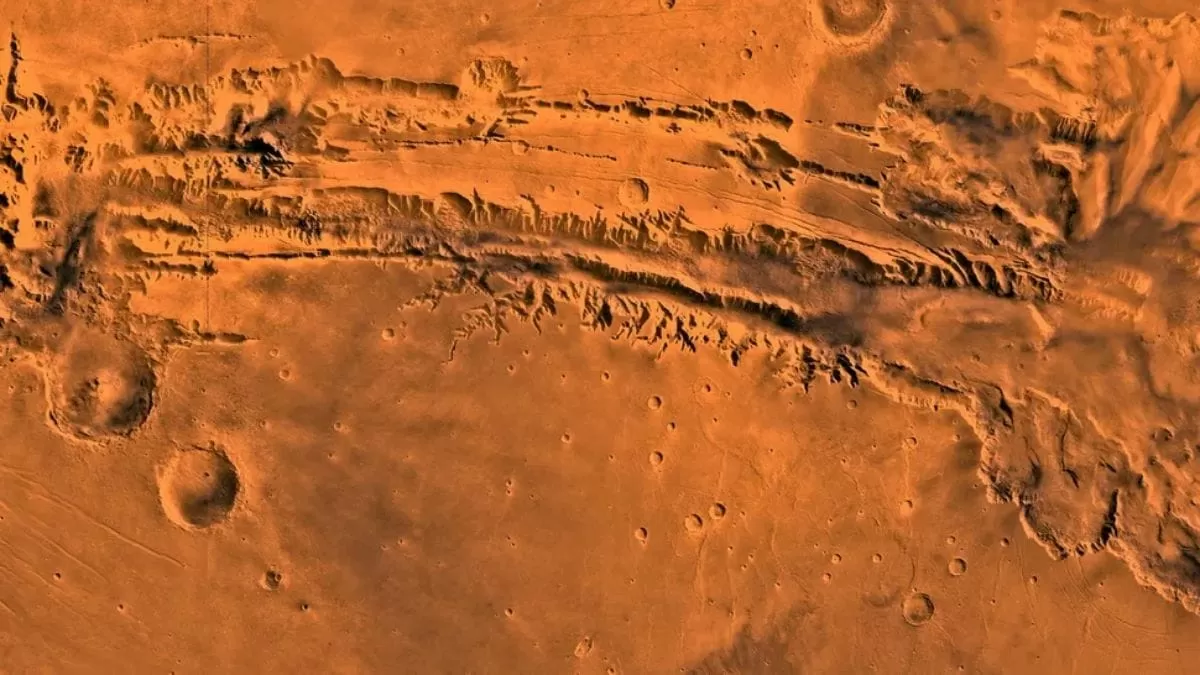
Mars, the fourth planet from the Sun, has been a subject of fascination and wonder for centuries. Its distinct red appearance has captured the imagination of scientists and the general public alike. But what is the science behind Mars’s red hue? In this article, we will delve into the fascinating world of planetary science and explore the reasons behind Mars’s red appearance.
The first thing that comes to mind when we think of Mars is its iconic red color. This is due to the presence of iron oxide or rust on its surface. The surface of Mars is rich in iron, and when this iron comes into contact with oxygen, it forms a reddish-brown compound known as iron oxide. This is the same process that occurs when iron is exposed to air on Earth, resulting in the formation of rust.
But why does Mars have so much iron on its surface? To understand this, we need to take a closer look at the planet’s history. It is believed that Mars was once a warm and wet planet, with a thick atmosphere and flowing rivers. However, over time, the planet lost its atmosphere and the water on its surface evaporated. This process exposed the iron-rich rocks on the surface to oxygen, resulting in the formation of iron oxide and giving Mars its distinctive red appearance.
While Mars is known as the Red Planet, images from rovers and data from telescopes have shown that the planet’s surface is not uniformly red. In fact, it has a wide range of colors, from tan to white ice caps. This is due to the presence of different minerals and compounds on the surface, such as basalt, which gives a dark brown color, and sulfur, which gives a yellowish tint. These variations in color add to the complexity and diversity of Mars’s surface.
But the true beauty of Mars’s colors can only be fully appreciated when observed in ultraviolet and infrared light. These wavelengths of light reveal deeper insights into the planet’s atmosphere, surface, and seasonal changes. For example, in ultraviolet light, the planet’s atmosphere appears blue, while in infrared light, the surface appears blue-green. This is because different materials on the surface absorb and reflect different wavelengths of light, providing valuable information to scientists studying Mars.
One of the most significant findings from observing Mars in ultraviolet and infrared light is the presence of water ice on the planet’s surface. The polar ice caps, which appear white in visible light, are actually made up of frozen water and carbon dioxide. These ice caps undergo seasonal changes, shrinking and growing with the planet’s changing seasons. This discovery has revolutionized our understanding of Mars and its potential for sustaining life.
Furthermore, observations in ultraviolet light have also revealed the presence of a thin layer of ozone in Mars’s atmosphere. Ozone is a crucial component of Earth’s atmosphere, protecting us from harmful solar radiation. Its presence on Mars suggests that the planet may have once had a thicker atmosphere, making it more habitable in the past.
Studying Mars’s seasonal changes has also been made possible through observations in ultraviolet and infrared light. These changes are caused by the planet’s tilt, similar to Earth’s seasons. However, due to Mars’s elliptical orbit, its seasons are more extreme, with temperatures varying by up to 50 degrees Celsius. This has a significant impact on the planet’s climate and weather patterns, and studying these changes can provide valuable insights into the planet’s past and future.
In conclusion, while the red appearance of Mars is primarily due to the presence of iron oxide on its surface, there is much more to this fascinating planet than meets the eye. Observations in ultraviolet and infrared light have enriched our understanding of Mars and its complex atmosphere, surface, and seasonal changes. As we continue to explore and study this enigmatic planet, we can only imagine what other secrets it holds and how it may have evolved over time. Mars truly is a testament to the wonders of planetary science and the endless possibilities of our universe.
