
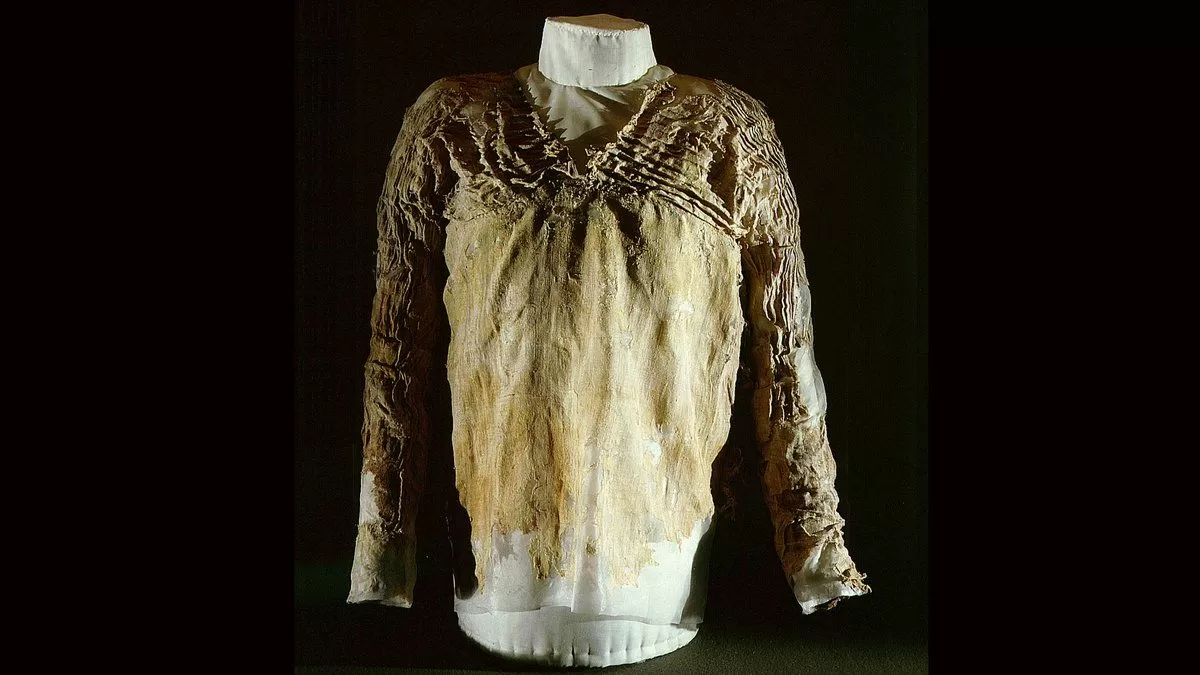
The world of fashion is constantly evolving, with new trends and styles emerging every season. But have you ever wondered about the origins of fashion? Where did it all begin? Well, the answer lies in the sands of Egypt, where the world’s oldest known tailored garment was discovered – the Tarkhan Dress.
Carbon-dated to 3482–3102 B.C., the Tarkhan Dress is a linen garment that was found in an Egyptian tomb near Cairo. It is believed to have been worn during Egypt’s First Dynasty, making it over 5000 years old. This remarkable discovery offers us a rare glimpse into the world of ancient fashion and provides valuable insights into early textile artistry and everyday life in ancient Egypt.
The Tarkhan Dress was first discovered in 1913 by British archaeologist Sir Flinders Petrie during his excavation of the Tarkhan cemetery. The cemetery was known for its well-preserved tombs, and it was in one of these tombs that Petrie found the linen dress. At first, he thought it was just a simple piece of cloth, but upon closer examination, he realized that it was a finely tailored garment.
The dress is made of linen, a fabric that was highly valued in ancient Egypt for its durability and ability to keep the wearer cool in the hot climate. The linen used in the Tarkhan Dress is of exceptional quality, with a thread count of over 100 threads per inch. This indicates that the dress was made for someone of high status, possibly a member of the royal family.
What makes the Tarkhan Dress even more fascinating is the fact that it is tailored. This means that it was not just a simple piece of cloth wrapped around the body, but rather a garment that was carefully cut and sewn to fit the wearer’s body. This suggests that the ancient Egyptians had a sophisticated understanding of garment construction and were skilled in the art of tailoring.
Experts believe that the Tarkhan Dress was not just a burial garment but was also worn in life. This is evident from the wear and tear on the dress, which indicates that it was used and washed multiple times. This is a rare find, as most ancient textiles are only found in burial contexts and have not been worn in life.
The dress offers us a glimpse into the fashion of ancient Egypt. It is a simple yet elegant garment, with a V-shaped neckline, short sleeves, and a pleated skirt. The pleats were created by folding the fabric and then stitching it in place, a technique that is still used in modern-day fashion. The dress also has decorative elements, such as a row of small buttons on the front and a belt made of twisted linen threads.
Apart from its design, the Tarkhan Dress also reveals insights into the daily life of ancient Egyptians. The dress was found with other items, such as sandals, jewelry, and cosmetics, suggesting that the person buried with it was someone of high status. It also tells us about the importance of clothing in ancient Egyptian society, where garments were not just practical but also served as a symbol of social status and identity.
The discovery of the Tarkhan Dress has shed light on the ancient art of tailoring and the sophisticated textile industry of ancient Egypt. It also challenges our perception of ancient civilizations as primitive and lacking in fashion sense. The fact that the dress was tailored and worn in life shows that the ancient Egyptians had a keen sense of style and were not afraid to experiment with fashion.
Today, the Tarkhan Dress is housed at the Petrie Museum of Egyptian Archaeology in London, where it continues to fascinate and inspire people from all over the world. It is a testament to the enduring legacy of ancient Egyptian culture and its influence on modern-day fashion.
In conclusion, the Tarkhan Dress is not just a piece of cloth, but a window into the world of ancient fashion and everyday life in ancient Egypt. Its discovery has given us a rare opportunity to understand and appreciate the artistry and craftsmanship of our ancestors. As we continue to evolve and innovate in the world of fashion, let us not forget the roots of this ever-changing industry and the timeless beauty of the Tarkhan Dress.
