
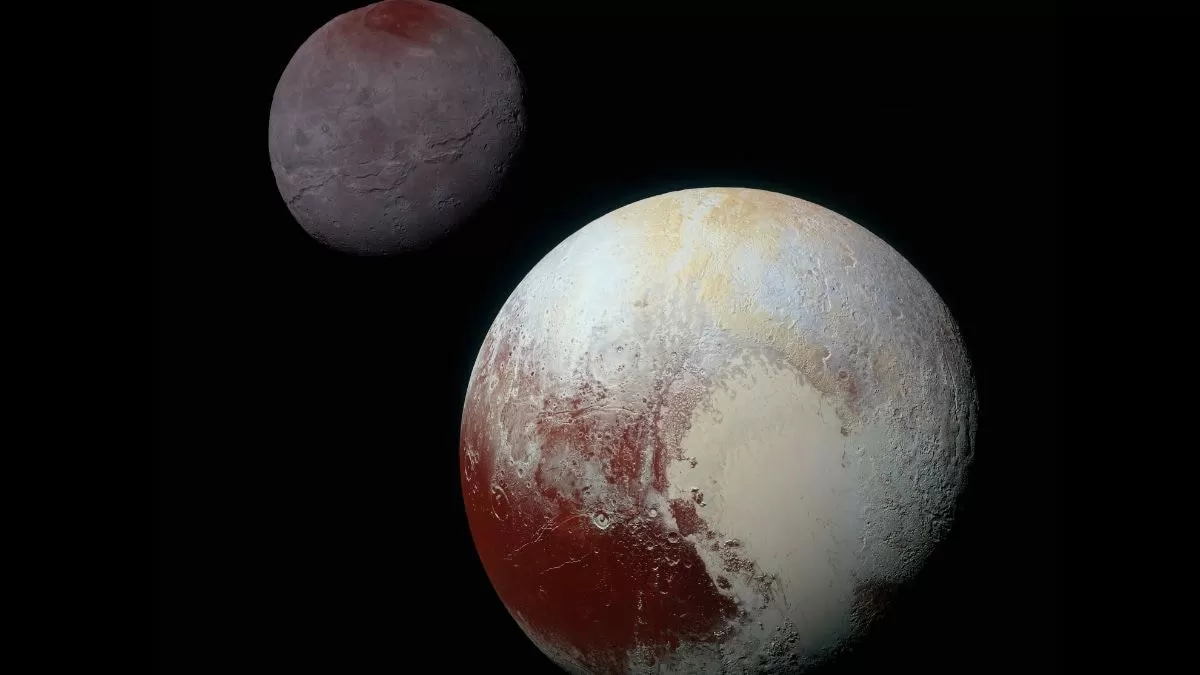
Pluto has always been a source of fascination for scientists and space enthusiasts alike. As the farthest planet in our solar system, it has remained a mysterious and tantalizing subject of study. And now, with the help of advanced technology and the new James Webb Space Telescope (JWST), we are getting even closer to unraveling the secrets of this distant world.
One of the recent breakthrough discoveries about Pluto is the confirmation of its thin haze of organic particles. These particles, found in the planet’s mesosphere, have been a subject of speculation for some time. But thanks to the powerful mid-infrared observations of the JWST, we now have concrete evidence of their existence. This finding has shed new light on the dynamic processes that shape Pluto’s atmosphere and its interaction with its largest moon, Charon.
But why is this discovery so significant? Well, let’s start by understanding what these organic particles are. Known as tholins, they are complex molecules that form as a result of high-energy radiation impacting the surface of Pluto. This radiation comes from the sun, cosmic rays, and even from other parts of the galaxy. These particles are made up of a mix of carbon, hydrogen, nitrogen, and oxygen, among other elements. And this unique mix gives them their reddish hue.
The study conducted by the JWST has revealed that Pluto’s thin haze of organic particles plays a crucial role in cooling its mesosphere. The mesosphere is the layer of the atmosphere located above the stratosphere, and it is where temperatures can reach as low as -240 degrees Celsius. This haze acts as a cooling agent, trapping heat and preventing it from escaping into space. Without this haze, the mesosphere would be much warmer, and the atmospheric dynamics of Pluto would be drastically different.
But the role of this haze doesn’t end there. It also plays a significant role in launching methane into space. Methane is a gas that is present in Pluto’s atmosphere, and it is an essential component in the planet’s atmospheric processes. The haze acts as a conveyor belt, transporting methane from the lower atmosphere to higher altitudes, where it can easily escape into space. This process is known as atmospheric escape, and it is essential for understanding the composition and evolution of Pluto’s atmosphere.
So where does Charon come into the picture? Charon is Pluto’s largest moon, and it has a unique relationship with the planet’s haze. The organic particles launched into space by the haze eventually make their way to Charon’s poles, where they are exposed to high levels of radiation. This radiation transforms the particles into tholins, giving Charon its reddish appearance. This phenomenon is similar to the process that gives Jupiter’s moon, Io, its distinct red color.
The discovery of Pluto’s haze has opened up a whole new area of study for scientists. By understanding how this haze shapes the planet’s atmosphere, we can gain valuable insights into the atmospheric processes of not only Pluto but also other planets in our solar system and beyond. This discovery has also highlighted the interconnectedness of celestial bodies and how they can influence each other’s evolution.
The JWST’s mid-infrared observations have allowed us to see Pluto in a whole new light. This state-of-the-art telescope has the capability to capture images and data with unprecedented detail and precision. Its advanced instruments and technology have enabled scientists to make groundbreaking discoveries and advance our understanding of the universe.
As we continue to explore the mysteries of our solar system, the discovery of Pluto’s thin haze of organic particles is undoubtedly a significant milestone. It has provided us with a deeper understanding of the dynamic processes that shape our universe and has opened up new avenues for research. The study also serves as a reminder of how much we still have to learn about our vast and wondrous universe.
In conclusion, the confirmation of Pluto’s thin haze of organic particles by the JWST’s mid-infrared observations is a remarkable achievement. It has shed new light on the planet’s atmospheric dynamics and its interaction with Charon. This discovery serves as a testament to the incredible capabilities of modern technology and highlights the importance of continued exploration in the quest to unravel the mysteries of our universe.
