
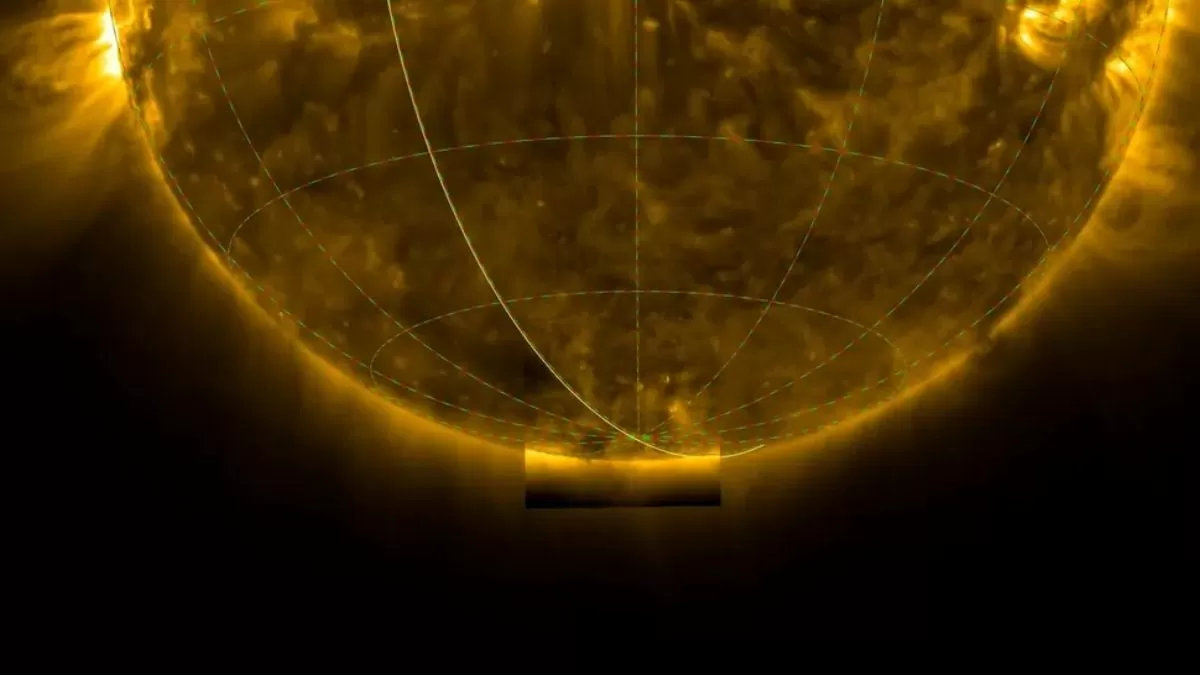
In a groundbreaking achievement, the European Space Agency’s (ESA) Solar Orbiter has captured the first-ever images of the Sun’s elusive south pole. This remarkable feat has provided scientists with a never-before-seen view of the intricate web of magnetic fields and solar winds that surround our closest star. The mission, which was launched in February 2020, is a major leap forward in our understanding of space weather and the 11-year solar cycle that has a profound impact on Earth’s environment.
The Solar Orbiter, a joint mission between ESA and NASA, is the result of over a decade of planning and collaboration between international space agencies. Its primary goal is to study the Sun and its influence on the space environment, providing valuable insights into the inner workings of our star. And with the recent images of the Sun’s south pole, the mission has already exceeded expectations.
The images captured by the Solar Orbiter’s cameras reveal a complex network of magnetic fields, with bright spots indicating areas of intense activity. These magnetic fields play a crucial role in shaping the Sun’s atmosphere and driving the solar wind, a stream of charged particles that constantly flows from the Sun and affects the entire solar system.
One of the most significant findings from these images is the presence of small-scale magnetic fields, which were previously undetected. These fields are thought to be responsible for the Sun’s constant activity and its 11-year solar cycle, which is marked by periods of increased and decreased solar activity. Understanding these cycles is crucial for predicting and preparing for potential space weather events that can impact Earth’s communication systems, power grids, and even astronauts in space.
The Solar Orbiter’s unique orbit also allows it to capture images of the Sun’s poles, which have been largely unexplored until now. Its elliptical orbit takes it as close as 42 million kilometers to the Sun, providing a view of the star’s polar regions that is not possible from Earth. This close proximity also allows for detailed measurements of the solar wind and other energetic particles that emanate from the Sun.
The mission’s success in capturing images of the Sun’s south pole is a testament to the incredible engineering and technological advancements that have made this mission possible. The spacecraft is equipped with a suite of ten scientific instruments, including cameras, spectrometers, and magnetometers, which work together to provide a comprehensive understanding of the Sun’s behavior.
The Solar Orbiter is also equipped with a heat shield made of titanium and ceramic, which can withstand temperatures of up to 520 degrees Celsius. This is essential for protecting the spacecraft’s sensitive instruments from the intense heat and radiation of the Sun.
The mission’s success has been met with excitement and praise from the scientific community, with many hailing it as a major milestone in solar exploration. ESA’s Director of Science, Günther Hasinger, described the images as “a glimpse of the Sun’s future” and emphasized the importance of the mission in advancing our understanding of the Sun and its impact on Earth.
The Solar Orbiter’s journey is far from over, and scientists are eagerly awaiting more images and data as the spacecraft continues its orbit around the Sun. With its unique perspective and advanced instruments, the mission is expected to provide groundbreaking insights into the Sun’s behavior and its influence on our planet.
In addition to its scientific importance, the Solar Orbiter’s achievements also serve as a reminder of the power of international collaboration and the incredible feats that can be accomplished when nations come together to explore the unknown. The mission is a testament to the capabilities of human ingenuity and highlights the endless possibilities that lie ahead in our quest to unravel the mysteries of the universe.
In conclusion, the Solar Orbiter’s historic first images of the Sun’s south pole have opened up a new chapter in solar exploration. With its groundbreaking discoveries and valuable insights, the mission is set to revolutionize our understanding of the Sun and its impact on Earth. This remarkable achievement is a testament to human curiosity and determination, and it serves as a reminder that the sky is not the limit when it comes to exploring the wonders of our universe.
