
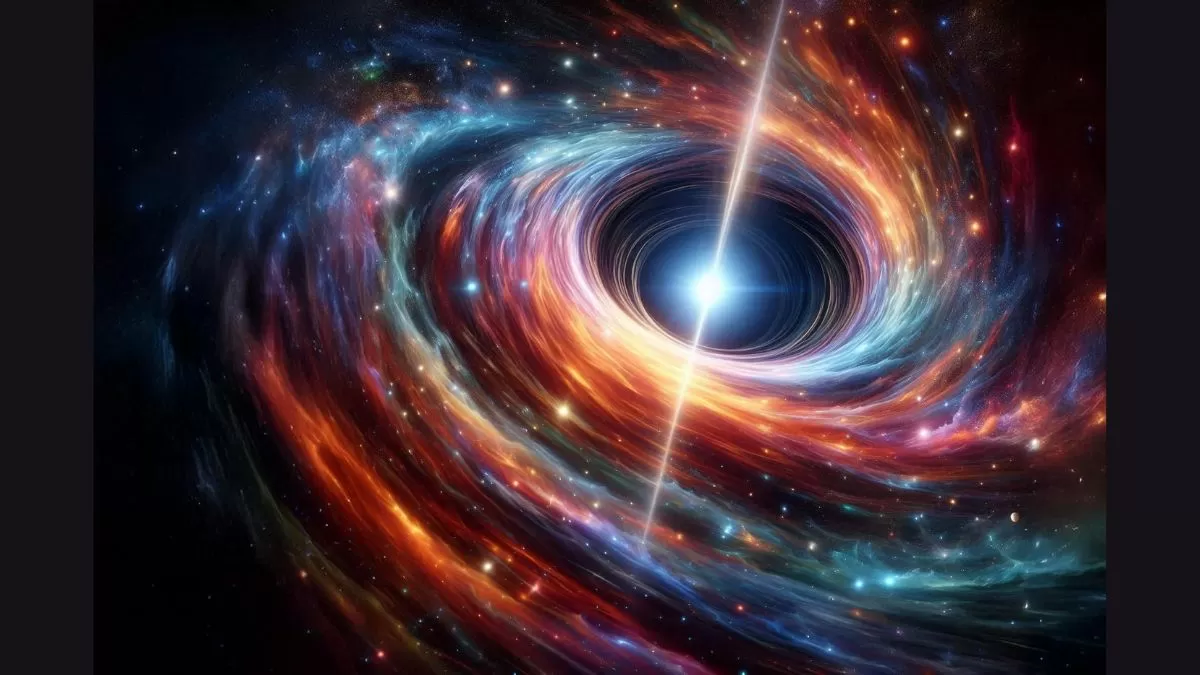
A new theory regarding black holes has recently emerged, proposing a solution to the long-standing singularity paradox. This theory suggests modifying the equations of gravity, but it has been met with skepticism from scientists like Nikodem Poplawski. While the theory may lack observational support and relies on speculative assumptions, Poplawski believes that future data from gravitational waves or the cosmic microwave background may one day reveal the true nature of these mysterious objects.
Black holes have fascinated and perplexed scientists and the general public alike for decades. These objects, with their intense gravitational pull that even light cannot escape, have long been a subject of scientific inquiry. However, the concept of a singularity, a point of infinite density at the center of a black hole, has always been a major stumbling block in our understanding of these enigmatic objects.
The singularity paradox raises the question of what happens to the laws of physics at this point of infinite density. Our current understanding of gravity, as described by Albert Einstein’s theory of general relativity, breaks down at the singularity. This has led to the search for a new theory that can reconcile the laws of gravity with the existence of a singularity.
Enter the new black hole theory proposed by a team of researchers led by Niayesh Afshordi of the Perimeter Institute for Theoretical Physics in Canada. This theory suggests modifying the equations of gravity to include a term that effectively removes the singularity, thereby solving the paradox. This modification, known as the “singularity resolution,” proposes that the singularity is replaced by a region of strong curvature, but one that is still finite and well-behaved.
While this may seem like a promising solution, it has been met with skepticism from some scientists, including Nikodem Poplawski, a physicist at Indiana University. Poplawski argues that the theory lacks observational support and relies on speculative assumptions. He believes that it is premature to claim that the singularity paradox has been solved and that more evidence is needed to support this new theory.
One of the major criticisms of the singularity resolution is the lack of observational evidence. The predictions made by this theory have not yet been tested or observed, making it difficult to verify its validity. As Poplawski points out, “A theory, no matter how elegant, must be supported by observational evidence in order to be accepted by the scientific community.”
However, proponents of the singularity resolution argue that future data from gravitational waves or the cosmic microwave background may provide the necessary evidence to support this theory. These are two of the most promising tools for studying black holes, and they have already provided valuable insights into their nature. With advancements in technology and data collection, it is possible that we may one day have the evidence needed to confirm the singularity resolution.
In the meantime, Poplawski suggests that we continue to explore other theories and approaches to understanding black holes. He believes that a combination of different theories may be necessary to fully explain the complex nature of these objects. As he states, “It is important to keep an open mind and consider all possibilities, rather than focusing on a single theory.”
Despite the lack of observational evidence, the singularity resolution has sparked a renewed interest in the study of black holes. It has opened up new avenues for research and has reignited the debate on the true nature of these enigmatic objects. Whether or not this theory proves to be the solution to the singularity paradox, it has certainly generated excitement and curiosity in the scientific community.
In conclusion, the new black hole theory proposing a fix to the singularity paradox may still be in its early stages and may lack observational support. However, it has sparked important discussions and has the potential to change our understanding of these mysterious objects. As we continue to gather data and explore different theories, we may one day uncover the true nature of black holes and their role in the universe.
