
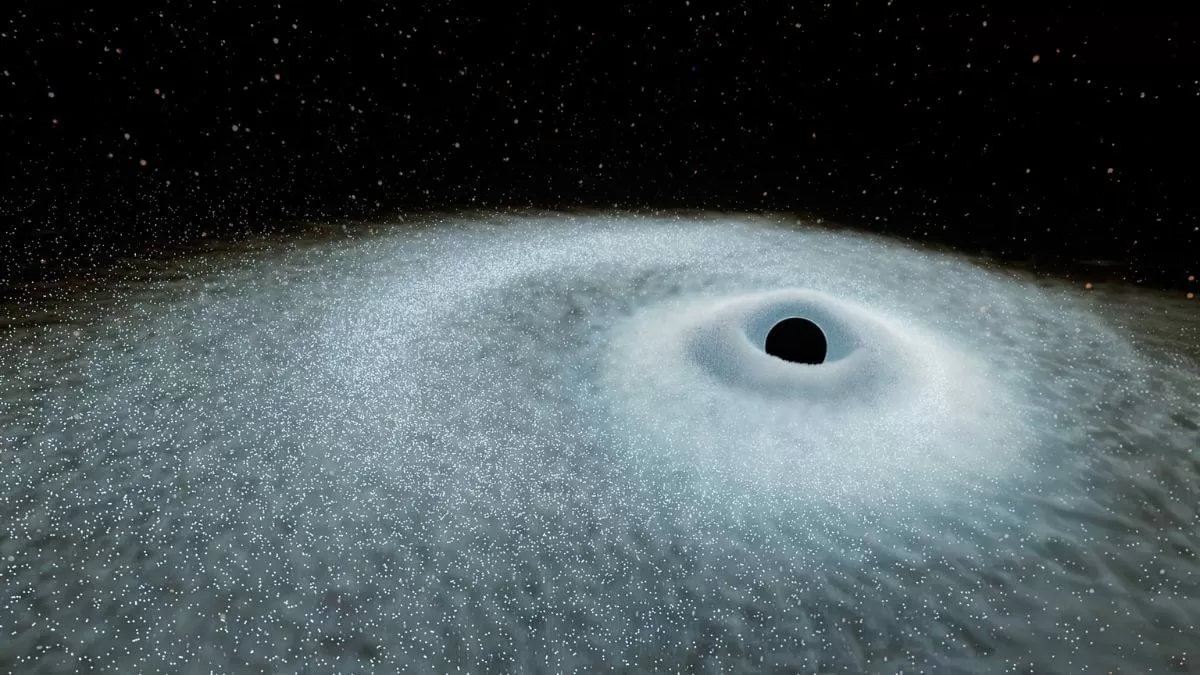
Astronomy, the study of the universe, never fails to amaze us with its incredible and unexpected discoveries. Recently, astronomers have made a groundbreaking discovery that sheds light on the extreme and mysterious phenomena occurring in our universe. With the help of the Gaia and Zwicky Transient Facility (ZTF), scientists have observed rare and powerful explosions, known as extreme nuclear transients, caused by the destruction of stars by supermassive black holes. These events, brighter and longer-lasting than supernovae, offer valuable insights into the growth and behavior of black holes, and could potentially revolutionize our understanding of the universe.
The discovery of extreme nuclear transients is a result of the collaboration between the European Space Agency’s Gaia satellite and the ZTF, a robotic survey telescope located at Palomar Observatory in California. The Gaia satellite, launched in 2013, is known for its precise measurements of the positions, movements, and distances of over a billion stars in our Milky Way galaxy. On the other hand, the ZTF is designed to scan the night sky for transient objects, such as supernovae and asteroids, that change in brightness over time.
In a paper published in the journal Nature Astronomy, a team of international astronomers has reported the detection of eight extreme nuclear transients, all originating from different galaxies, using data from Gaia and ZTF. These powerful events occur when a star gets too close to a supermassive black hole, which can have a mass equivalent to billions of suns, and is ripped apart by its intense gravitational pull. The resulting explosion can release energy equivalent to a thousand supernovae, making it the most energetic cosmic outburst since the Big Bang.
One of the extreme nuclear transients observed, called AT2018cow or “The Cow”, was first detected by the ZTF in June 2018. This explosion was 10 times brighter than a typical supernova and lasted for about two months, making it one of the most mysterious and intriguing astronomical events in recent years. The Cow has baffled astronomers with its unusual features, such as the lack of hydrogen in its spectrum and its rapid increase in brightness, which cannot be explained by any known astrophysical phenomenon.
The discovery of extreme nuclear transients offers a unique opportunity for astronomers to study the behavior of supermassive black holes and their interaction with stars. These events can help us understand how black holes grow in size and shape the galaxies they reside in. “The extreme nuclear transients we discovered offer a glimpse into a previously unseen phase of black hole evolution,” said Dr. Anna Ho, lead author of the study and a postdoctoral researcher at Caltech.
Furthermore, these events provide valuable insights into the rate at which stars are being destroyed by black holes. According to Dr. Nicholas Stone, an astronomer at the Hebrew University of Jerusalem and co-author of the study, “Extreme nuclear transients are extremely rare, occurring in only one out of every 10,000 galaxies per year. This makes them 100 times rarer than supernovae.”
The detection of these extreme nuclear transients also opens up new avenues for future research. Astronomers are now looking for more of these events to better understand their properties and evolution. They also plan to study the surroundings of supermassive black holes in more detail, which can provide clues about the conditions that lead to these powerful explosions.
The discovery of extreme nuclear transients is another example of how advancements in technology and collaborations among scientists are leading to groundbreaking discoveries in astronomy. With the help of Gaia and ZTF, astronomers are now able to observe and study these rare and extreme events, which were previously thought to be too faint to detect. This discovery also highlights the importance of multi-wavelength observations, combining data from different instruments and telescopes, to gain a complete understanding of the universe.
In conclusion, the discovery of extreme nuclear transients by the Gaia and ZTF collaboration is a major milestone in our quest to understand the mysteries of the universe. These rare and powerful explosions offer valuable insights into the growth and behavior of supermassive black holes, and could potentially revolutionize our understanding of the cosmos. With further research, we can hope to unlock more secrets of these extreme events and gain a deeper understanding of the universe we live in.
