
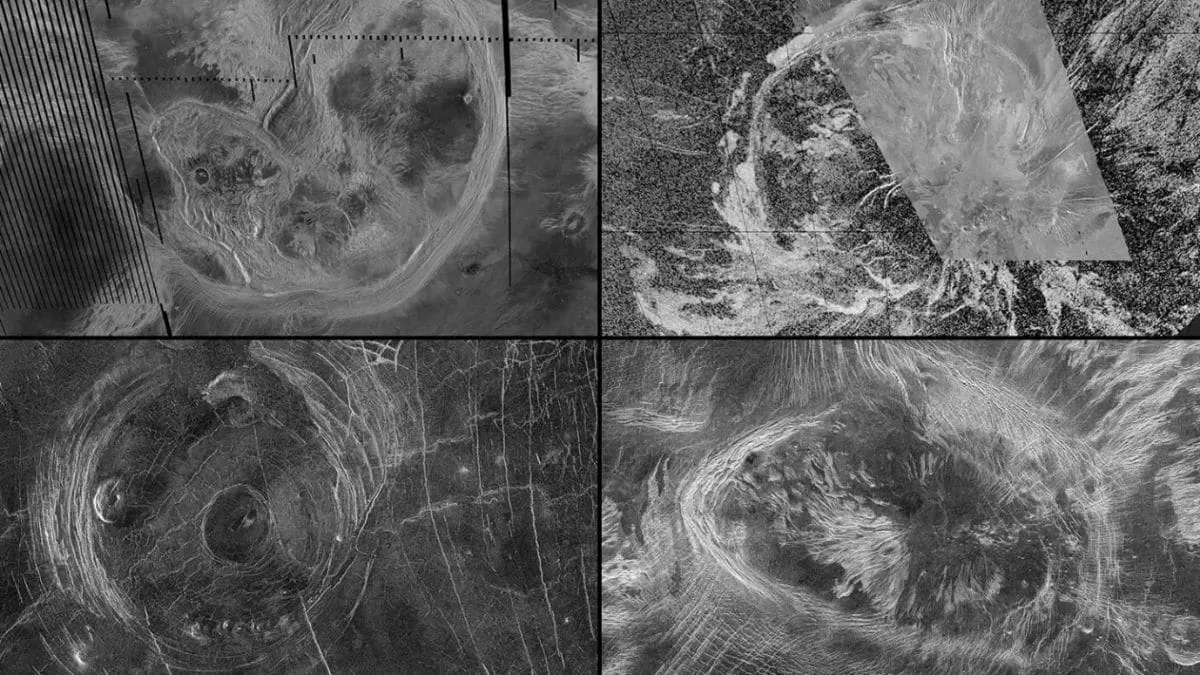
Is Venus still geologically alive? This is a question that has puzzled scientists for decades. While Venus is often referred to as Earth’s “sister planet” due to their similar size and composition, it has long been believed that Venus is a geologically dead world. However, new findings using NASA’s Magellan data have revealed that the planet’s surface may still be actively reshaped by subsurface plumes, supporting the idea of modern tectonic activity on Venus.
The Magellan spacecraft, which orbited Venus from 1990 to 1994, collected high-resolution radar images of the planet’s surface. These images have been studied by scientists for years, but it wasn’t until recently that a team of researchers from the University of Maryland and the Institute of Geophysics at ETH Zurich made a groundbreaking discovery.
Using advanced computer simulations, the team was able to recreate the geological processes that have shaped Venus’ surface. They found that the planet’s surface is constantly being reshaped by subsurface plumes of hot material, similar to the ones that drive plate tectonics on Earth. This finding challenges the long-held belief that Venus is a geologically dead planet, and has significant implications for future planetary exploration.
One of the key pieces of evidence for this discovery is the presence of “pancakes” on Venus’ surface. These pancake-shaped features, also known as coronae, are created when hot plumes of material rise from the planet’s interior and push up against the surface. The team’s simulations showed that these coronae could only form if Venus’ surface was still active and capable of being deformed by these subsurface plumes.
This finding is particularly significant because Venus’ surface is believed to be much older than Earth’s. While Earth’s surface is constantly being renewed through plate tectonics, Venus’ surface is estimated to be around 700 million years old. This means that the geological activity on Venus has been going on for a much longer time, possibly even longer than on Earth.
The team’s findings also have implications for the search for life on other planets. While Venus’ surface is inhospitable to life due to its extreme temperatures and thick atmosphere, the discovery of active geological processes raises the possibility that there may be subsurface environments on Venus that could potentially support life. This opens up new avenues for future missions to Venus, which have largely focused on studying the planet’s atmosphere and surface.
The discovery also has implications for our understanding of the formation and evolution of planets. Venus is believed to have formed at the same time as Earth, but the two planets have evolved very differently. While Earth has a dynamic surface with plate tectonics, Venus’ surface has remained relatively unchanged. The team’s findings suggest that the differences in the geological activity of the two planets may be due to variations in their internal structures.
The team’s research has been published in the journal Nature Geoscience, and has already garnered significant attention from the scientific community. Dr. Paul Byrne, a planetary geologist at North Carolina State University who was not involved in the study, called the findings “very exciting” and said that they “provide a new perspective on Venus’ geological evolution.”
However, there is still much to be learned about Venus and its geological processes. The team’s simulations are based on assumptions about the planet’s interior, which may not be entirely accurate. Further research and exploration will be needed to confirm the team’s findings and gain a better understanding of the inner workings of Venus.
In conclusion, the latest findings using NASA’s Magellan data have challenged our long-held beliefs about Venus being a geologically dead planet. The presence of subsurface plumes and active tectonic processes on Venus’ surface provide compelling evidence that the planet is still geologically alive. This discovery has important implications for our understanding of planetary evolution, the search for life on other worlds, and future missions to Venus. As we continue to unravel the mysteries of our solar system, Venus is proving to be a fascinating and dynamic world that is deserving of further exploration.
