
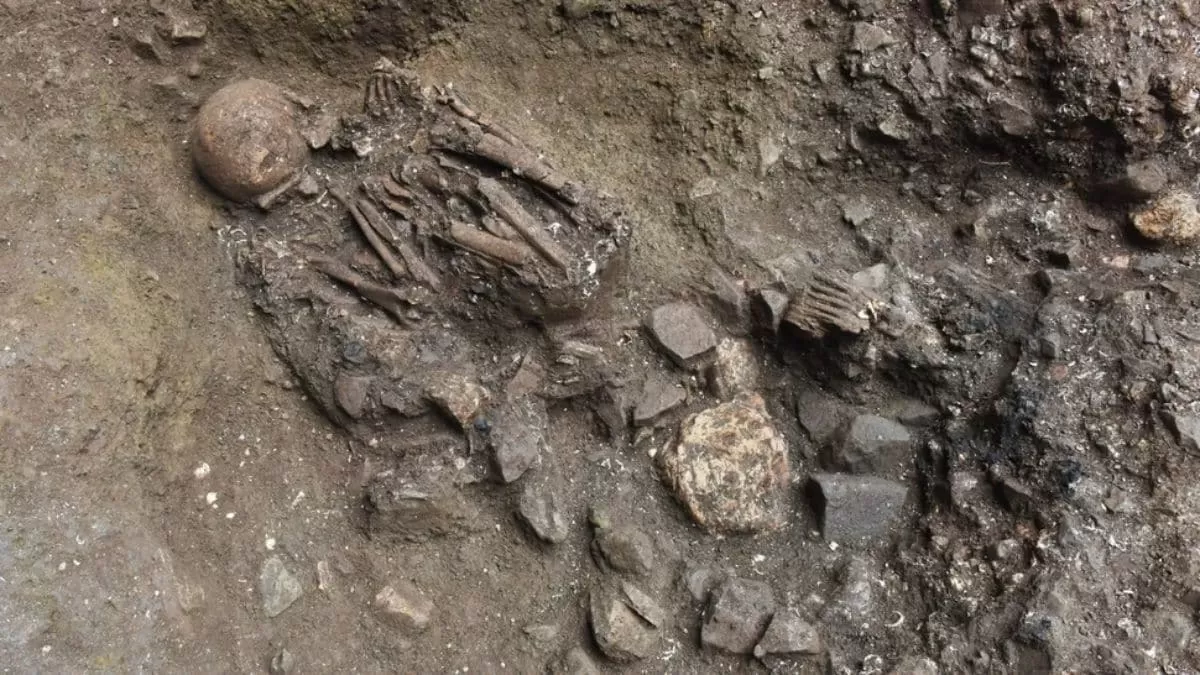
A groundbreaking study of a 7,100-year-old skeleton found in Yunnan, China, has revealed a “ghost” human lineage that was previously unknown. This discovery has shed new light on the history of human evolution and has the potential to change our understanding of ancient human populations.
The skeleton, named Xingyi_EN, belonged to a woman who lived during the Neolithic period in what is now modern-day China. She was a member of a deeply divergent group called the Basal Asian Xingyi lineage, which was previously only known through genetic inference. This group is believed to have contributed to the genetic makeup of modern Tibetans.
The study, published in the journal Nature, was conducted by an international team of researchers led by scientists from the Chinese Academy of Sciences and the Max Planck Institute for the Science of Human History. The team used advanced genetic analysis techniques to extract DNA from the skeleton and compare it to the genomes of modern and ancient humans.
The results of the study were surprising and groundbreaking. They revealed that Xingyi_EN belonged to a distinct and previously unknown human lineage that diverged from the ancestors of modern humans over 100,000 years ago. This makes her one of the oldest human remains ever found in East Asia.
The discovery of this “ghost” lineage has important implications for our understanding of human evolution. It suggests that there were multiple waves of human migration and interbreeding in Asia, which has been a hotly debated topic among scientists. This finding also challenges the traditional view that modern humans originated in Africa and then spread to other parts of the world.
But perhaps the most significant aspect of this study is the potential link between the Basal Asian Xingyi lineage and modern Tibetans. The researchers found that Xingyi_EN shared genetic similarities with modern Tibetans, indicating that this ancient group may have contributed to the genetic makeup of modern Tibetans. This is a groundbreaking discovery that could change our understanding of the origins of the Tibetan people.
The study also revealed evidence of a distinct genetic adaptation in Xingyi_EN that is commonly found in modern Tibetans. This adaptation allows the body to cope with high altitudes, which is a characteristic of the Tibetan Plateau. This suggests that the Basal Asian Xingyi lineage may have been well adapted to living in high altitudes, which could explain their contribution to the genetic makeup of modern Tibetans.
The discovery of Xingyi_EN and the Basal Asian Xingyi lineage is a testament to the power of genetic analysis in uncovering the mysteries of our past. It also highlights the importance of preserving and studying ancient human remains, as they hold valuable information about our evolutionary history.
This groundbreaking study has opened up new avenues for research and has the potential to change our understanding of human evolution in Asia. It has also sparked excitement and curiosity among scientists and the general public alike. The discovery of this “ghost” human lineage has captured the imagination of people around the world and has the potential to rewrite the history books.
The study of Xingyi_EN and the Basal Asian Xingyi lineage is a testament to the resilience and adaptability of the human species. It is a reminder that our ancestors were a diverse and complex group, and that our genetic makeup is a result of thousands of years of migration and interbreeding.
In conclusion, the discovery of the 7,100-year-old skeleton in Yunnan, China, has revealed a “ghost” human lineage that was previously unknown. This groundbreaking study has the potential to change our understanding of human evolution and has shed new light on the history of ancient human populations. It is a testament to the power of scientific research and the importance of preserving and studying ancient human remains. This discovery has captured the imagination of people around the world and has the potential to rewrite the history books.
