
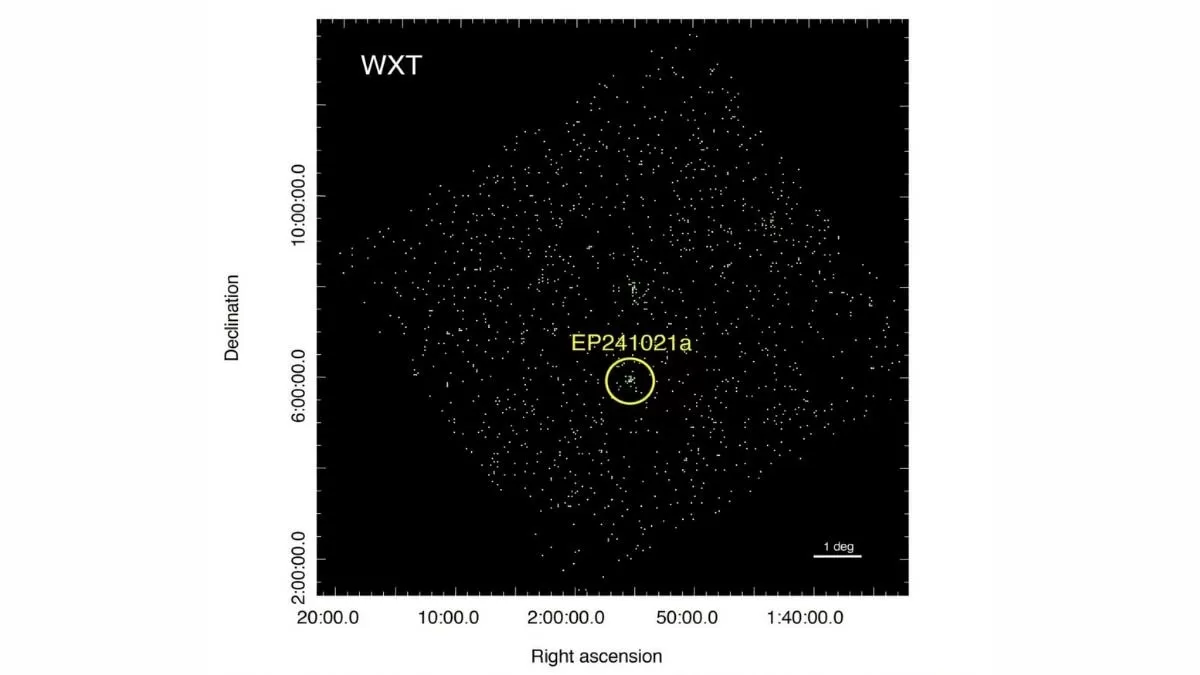
An international team of astronomers has made an exciting discovery using China’s Einstein Probe. In a recent paper published on May 12th in arXiv, the team revealed the detection of a peculiar fast-evolving X-ray transient, EP241021a. This discovery has caught the attention of the scientific community due to its unique characteristics and has opened up new possibilities for further research.
The transient, EP241021a, stood out from other fast-evolving X-ray transients (FEXTs) due to its long-lasting emissions that lasted over 79 days. This is an unprecedented duration for FEXTs, which typically only last for a few days. The team was able to observe this phenomenon using the Einstein Probe’s X-ray telescope, which is designed to detect and study high-energy X-rays in the universe.
But what exactly is a fast-evolving X-ray transient? These are astronomical events that produce a sudden and intense burst of X-rays, which then quickly fade away. They are believed to be caused by the collapse of a massive star or the merger of two compact objects, such as neutron stars or black holes. These events are rare and unpredictable, making them a challenging subject for astronomers to study.
EP241021a, however, has provided a unique opportunity for scientists to study a FEXT in detail. The team was able to observe the transient’s X-ray emissions for an extended period, allowing them to gather valuable data and insights into its behavior. They found that the X-ray emissions from EP241021a were not only long-lasting but also varied in intensity, which is another unusual characteristic for FEXTs.
But that’s not all. The team also detected optical and radio emissions from EP241021a, which is a significant discovery. This suggests that the transient has a multi-component structure, meaning that it is not just a single event but a complex system with multiple components. This finding has opened up new avenues for research and has sparked a lot of interest among astronomers.
The detection of optical and radio emissions from EP241021a is particularly exciting because it provides a more comprehensive understanding of the transient. By studying these emissions, scientists can gain insights into the physical processes that are taking place within the transient. This can help them to unravel the mystery behind FEXTs and shed light on the nature of these enigmatic events.
The team’s discovery of EP241021a also highlights the importance of international collaboration in the field of astronomy. The Einstein Probe, which is operated by the Chinese Academy of Sciences, is a joint project with contributions from several international partners, including the United States, Switzerland, and Italy. This collaboration has enabled scientists from different countries to work together and share their expertise, leading to groundbreaking discoveries like EP241021a.
The detection of EP241021a is a significant achievement for the Einstein Probe and a testament to its capabilities. Launched in 2017, the probe is China’s first space telescope dedicated to studying high-energy X-rays. It has already made several important discoveries, including the detection of a supermassive black hole in the center of a distant galaxy. With its advanced technology and instruments, the Einstein Probe is expected to make many more groundbreaking discoveries in the future.
The team’s findings on EP241021a have been met with great enthusiasm by the scientific community. It has opened up new possibilities for studying FEXTs and has provided valuable insights into the physical processes that drive these events. The team is now planning to conduct further observations of EP241021a and other FEXTs to gather more data and deepen our understanding of these mysterious phenomena.
In conclusion, the detection of EP241021a by the international team of astronomers using China’s Einstein Probe is a significant achievement in the field of astronomy. This peculiar fast-evolving X-ray transient has provided valuable insights into the nature of FEXTs and has opened up new avenues for research. With the continued efforts of international collaborations and advanced technology, we can expect to uncover more secrets of the universe and expand our knowledge of the cosmos.
