
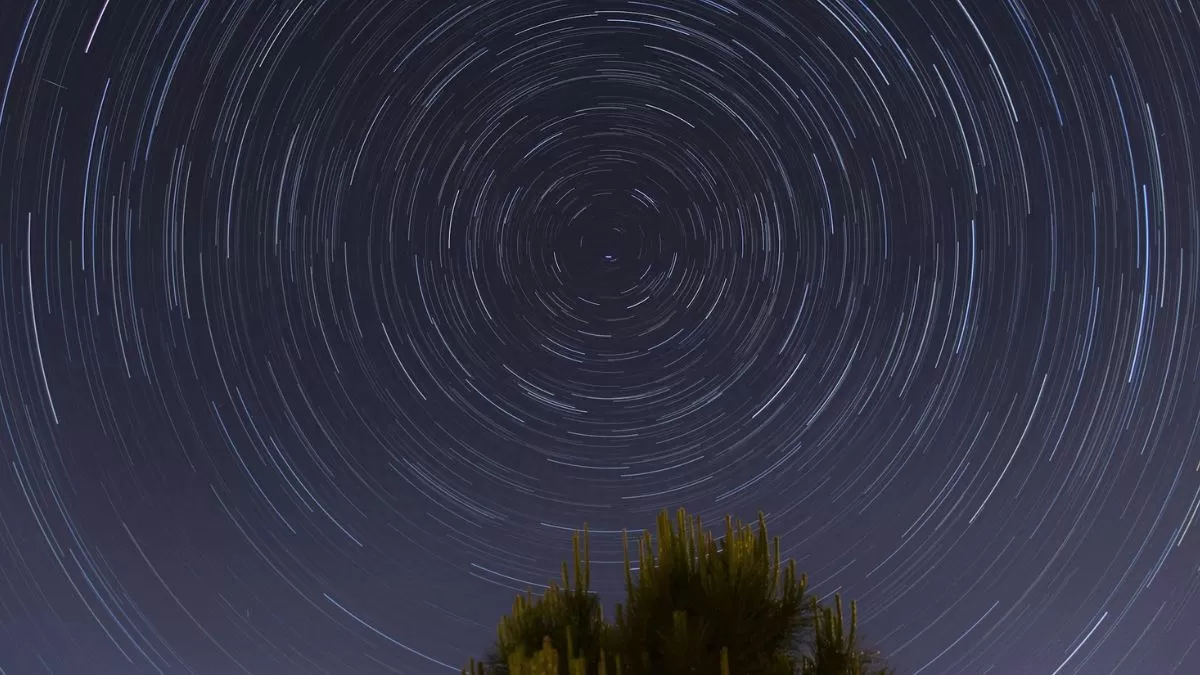
The night sky has always been a source of wonder and fascination for humanity. For centuries, we have gazed up at the stars, finding solace and guidance in their twinkling lights. However, what many of us may not realize is that the stars we see today are not the same ones that guided our ancestors. In fact, Earth’s 26,000-year axial precession is causing a gradual shift in the celestial pole, leading to the replacement of Polaris with new North Stars over millennia. Stars like Thuban, Kochab, Errai, and Vega have taken turns guiding humanity, and more will follow. This cosmic phenomenon, driven by gravitational forces, serves as a powerful reminder that even the seemingly constant night sky is ever-changing.
The concept of Earth’s axial precession may seem complex, but it is simply the gradual change in the orientation of Earth’s axis of rotation. This means that over thousands of years, the North Pole will not always point towards the same spot in the sky. As a result, the North Star, which is the star closest to the North Pole, will also change. Currently, Polaris holds this position, but it will not always be the case.
In the ancient world, the star Thuban in the constellation of Draco served as the North Star around 4,500 years ago. This was during the time of the ancient Egyptians, who used Thuban’s position in the sky to align their pyramids. The star was also known as the ‘Dragon’s Tail’ and was considered a symbol of power and protection.
As Earth’s axis continued to precess, the North Star position shifted to Kochab in the constellation of Ursa Minor around 1,000 BC. This star was important to the ancient Greeks, who associated it with the goddess Athena and used it to navigate their ships at sea. Kochab’s name means ‘star’ in Arabic, and it was believed to bring good luck and success.
Around 500 AD, the star Errai in the constellation of Cepheus took over as the North Star. Errai, also known as Gamma Cephei, is a binary star system, meaning it consists of two stars orbiting each other. This made it a unique and significant star to many ancient cultures, including the Chinese, who used it to measure time and track the seasons.
Finally, around the year 14,000 AD, the star Vega in the constellation of Lyra will become the North Star. Vega is one of the brightest stars in the sky and has been revered by many cultures throughout history. In ancient India, it was known as the ‘Star of Knowledge’ and was associated with the goddess Saraswati. In Greek mythology, Vega was linked to the goddess of justice, Themis, and was believed to bring balance and harmony.
However, the cycle does not end there. As Earth’s axial precession continues, other stars will take their turn as the North Star. In fact, NASA predicts that in 25,800 AD, the star Alderamin in the constellation of Cepheus will become the new North Star. This cycle will continue for thousands of years, with other stars such as Deneb in the constellation of Cygnus and Polaris Australis in the constellation of Octans taking their turn as the guiding star.
This cosmic wobble, caused by gravitational forces from the Sun and Moon, reminds us that the universe is constantly in motion. It is a humbling reminder that even the most seemingly stable and constant phenomena, such as the night sky, are ever-changing. It also serves as a reminder of our place in the universe and how we are connected to the cosmic dance of the stars.
As we continue to gaze up at the night sky, let us marvel at the beauty and wonder of the stars that have guided humanity for thousands of years. Let us also remember that these stars will continue to change and guide us in new ways, reminding us to embrace change and the unknown. The North Star may not always be Polaris, but it will always be a symbol of guidance and hope for humanity.
