
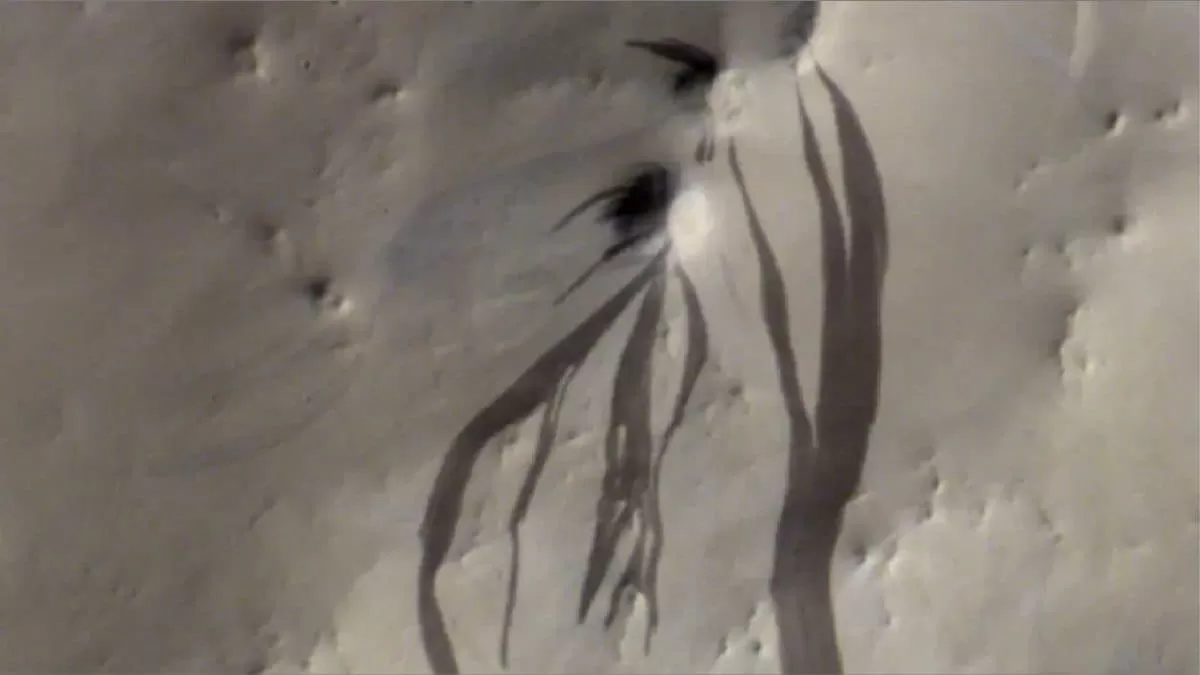
A new study conducted by researchers at Brown University and the University of Bern has shed new light on the mysterious recurring slope lineae (RSLs) found on the surface of Mars. Using advanced machine learning techniques, the team analyzed over 86,000 high-resolution images of the Red Planet and made a groundbreaking discovery. Contrary to previous beliefs, these dark streaks are not indicative of liquid water, but rather are caused by dry processes such as wind and dust movement. This study, which has mapped over 500,000 features on Mars, has the potential to change our understanding of the planet’s geological processes and its potential for sustaining life.
The presence of RSLs on Mars has long been a topic of fascination for scientists and space enthusiasts alike. These dark streaks, which appear to flow down the slopes of Martian craters and canyons during warmer seasons, were initially thought to be evidence of liquid water. This theory was based on the fact that RSLs seemed to darken and lengthen during the warmer months, leading to the belief that they were caused by the flow of water. However, the new study has challenged this assumption and provided a new explanation for the formation of RSLs.
The team of researchers, led by Dr. James Dickson from Brown University and Dr. Jan Raack from the University of Bern, used a machine learning algorithm to analyze thousands of images of RSLs taken by NASA’s Mars Reconnaissance Orbiter. This advanced technology allowed them to map over 500,000 features on the Martian surface, including RSLs and other geological formations. By analyzing the images, the team was able to identify patterns and characteristics that could help determine the cause of RSLs.
The results of the study were surprising and have challenged the long-held belief that RSLs are formed by the flow of liquid water. The team found that RSLs are more likely to occur on slopes that face the equator, where the winds are stronger and more frequent. This suggests that the dark streaks are caused by dry processes such as wind and dust movement, rather than the flow of water. The team also found that RSLs are more likely to occur on slopes with a steeper angle, which further supports the theory that they are formed by dry processes.
Dr. Dickson, the lead author of the study, explains, “Our findings suggest that RSLs are not evidence of liquid water on Mars, but rather are caused by dry processes such as wind and dust movement. This is a significant discovery that challenges our previous understanding of the planet’s geological processes.” He further adds, “By mapping over 500,000 features on Mars, we have been able to gain a better understanding of the planet’s surface and its potential for sustaining life.”
The study has also raised questions about the potential for life on Mars. The presence of liquid water is considered a key factor in determining a planet’s habitability. However, with the new findings, the possibility of liquid water on Mars has been called into question. This could have a significant impact on future missions to the Red Planet, as scientists may need to reconsider their approach to searching for signs of life.
The use of machine learning in this study has also opened up new possibilities for future research on Mars. By analyzing large amounts of data, scientists can gain a better understanding of the planet’s surface and its geological processes. This could lead to further discoveries and advancements in our understanding of Mars and its potential for sustaining life.
The study conducted by the team at Brown University and the University of Bern has provided a new perspective on the formation of RSLs on Mars. By challenging the long-held belief that these dark streaks are caused by liquid water, the study has opened up new avenues for research and has the potential to change our understanding of the Red Planet. With the use of advanced technology and innovative techniques, we are one step closer to unraveling the mysteries of Mars and unlocking its secrets.
