
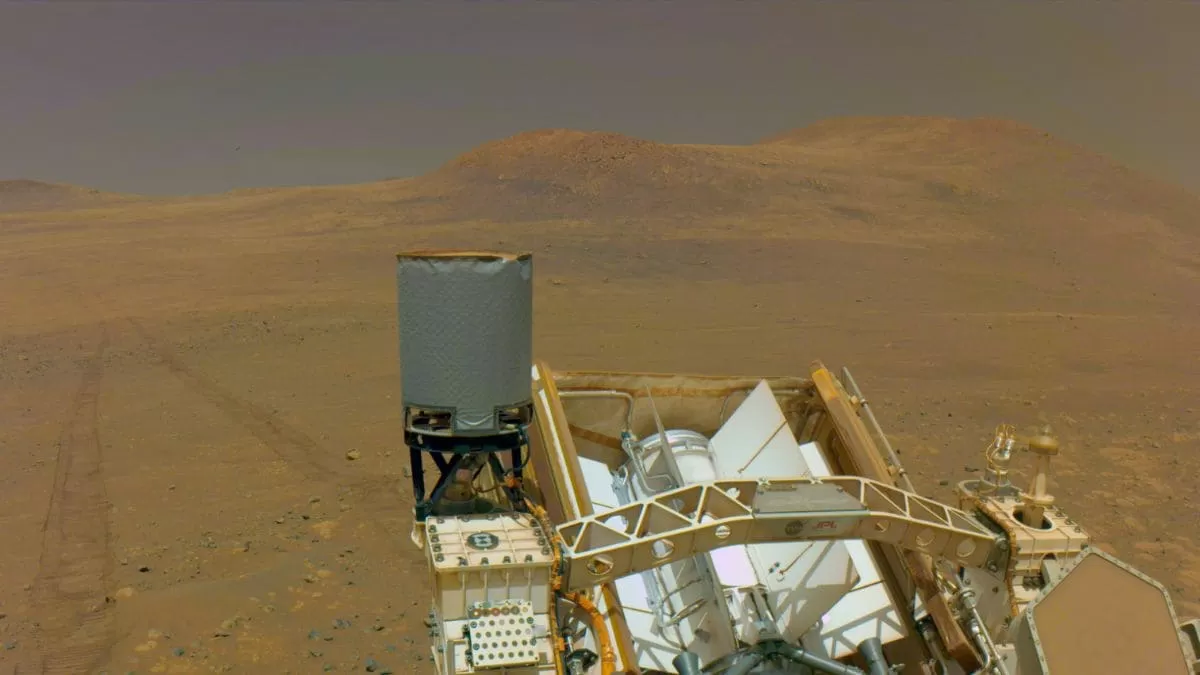
NASA’s Perseverance rover has reached another milestone in its mission to explore the red planet. After landing in Jezero Crater on February 18, 2021, the rover has now made its way to Krokodillen, a 73-acre plateau near the crater’s rim. This is an exciting development as Krokodillen is believed to host some of the oldest rocks on Mars. Preliminary data from the rover’s instruments has shown promising signs of past water activity in the area.
The Perseverance rover, also known as the Mars 2020 rover, is a state-of-the-art robotic explorer designed and built by NASA’s Jet Propulsion Laboratory. Its main goal is to search for signs of ancient microbial life on Mars and collect samples of rock and soil for future analysis on Earth. The rover’s journey to Krokodillen was no easy feat, as it had to navigate through difficult terrain and avoid potential hazards along the way.
Upon reaching Krokodillen, the rover immediately began its scientific investigations. Using its suite of instruments, including the Mastcam-Z, SuperCam, and PIXL, Perseverance has been scanning the area for any interesting features or minerals. And the results so far have been very promising.
Preliminary data from the rover’s instruments has shown the presence of clays, carbonates, and olivine minerals in the rocks at Krokodillen. These minerals are known to form in the presence of water, suggesting that there may have been a significant amount of water activity in this area in the past. This is a significant discovery as it adds to the growing evidence that Mars was once a habitable planet.
The rover is currently examining a specific site on Krokodillen named Copper Cove. This site was chosen based on the data gathered from orbiting spacecraft and will be the first location where Perseverance will collect samples of unsealed rock core. This new sampling strategy is a major advancement in Mars exploration as it allows the rover to collect pristine samples that have not been exposed to the harsh Martian environment.
The samples collected from Copper Cove will be stored in sealed tubes and eventually brought back to Earth by a future mission. These samples will be studied by scientists using advanced laboratory techniques to search for signs of past microbial life. This is an exciting prospect as it could potentially answer one of the biggest questions in human history: are we alone in the universe?
But the rover’s work at Krokodillen doesn’t end with sample collection. Perseverance will also be using its instruments to study the geology of the area and search for any other interesting features. The Mastcam-Z will provide high-resolution images of the rocks, while the SuperCam will use a laser to analyze the composition of the rocks from a distance. The PIXL instrument will also come into play, using X-rays to study the chemical makeup of the rocks.
The rover’s journey to Krokodillen and its ongoing investigations are a testament to the incredible engineering and technological capabilities of NASA. The success of this mission would not have been possible without the hard work and dedication of the team behind it. Their perseverance has truly paid off, and we can’t wait to see what other discoveries Perseverance will make in the future.
The exploration of Krokodillen is just the beginning for the Perseverance rover. It has a planned mission duration of one Mars year (equivalent to about two Earth years) and will continue to explore the Jezero Crater and its surrounding areas. This is a crucial step in NASA’s long-term goal of sending humans to Mars, and the data gathered by Perseverance will be vital in planning future human missions.
As we eagerly await the next updates from the rover, let us take a moment to appreciate the incredible feat that has been achieved. Perseverance has traveled over 293 million miles to reach Mars, and it is now exploring a site that could potentially hold the key to understanding the planet’s past. This is a remarkable achievement and a testament to the human spirit of exploration and discovery.
In conclusion, NASA’s Perseverance rover has reached Krokodillen, a 73-acre plateau near Jezero Crater’s rim, and has already made significant discoveries. Its ongoing investigations at a site named Copper Cove will provide valuable insights into Mars’ past and the potential
