
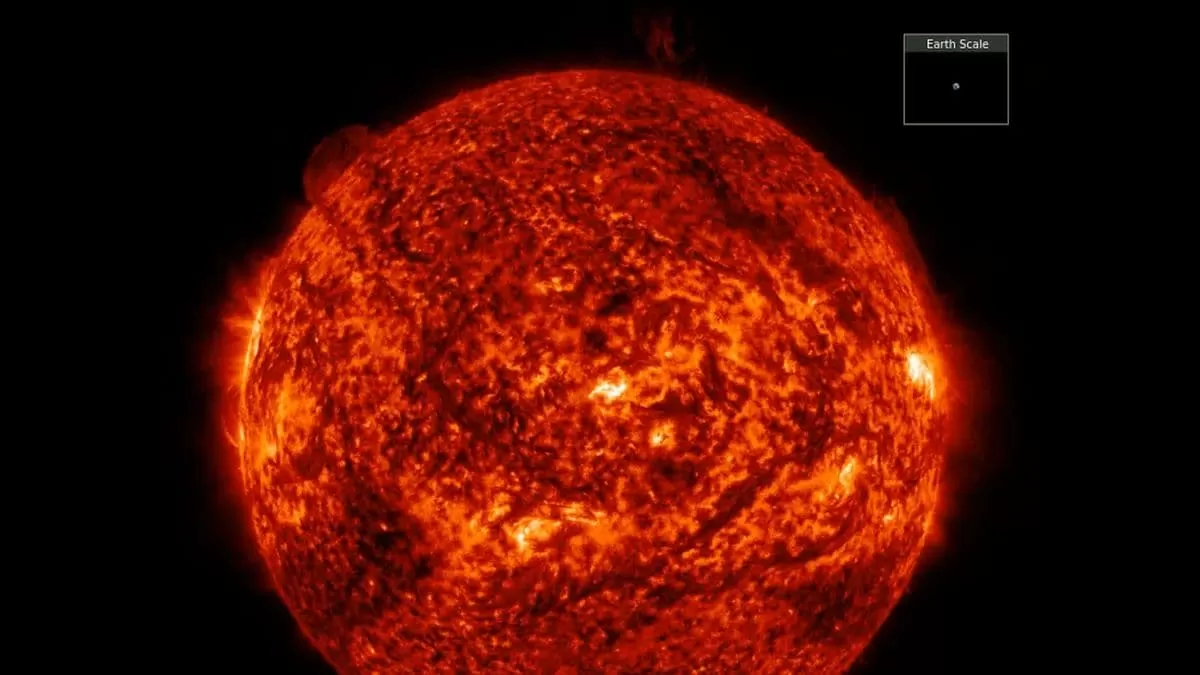
The sun is a spectacular and ever-changing celestial body that never ceases to amaze us with its powerful displays of energy. Recently, a 600,000-mile-long solar filament erupted off the sun’s surface in a fiery blast captured on video, leaving experts in awe and on the edge of their seats. While the resulting Coronal Mass Ejection (CME) will miss Earth, it serves as a reminder of the sun’s ongoing volatility and the potential for more powerful outbursts as Solar Cycle 25 approaches its peak.
The solar filament, which is a vast loop of magnetic fields holding dense, cool gas above the sun’s surface, was captured by NASA’s Solar Dynamics Observatory (SDO) on November 29th. In the video footage, the filament can be seen rising high into the sun’s atmosphere before collapsing back onto the surface in a spectacular display of fiery eruptions.
According to experts, the eruption of this massive solar filament is a rare and significant event as it is one of the largest ever recorded. It is a prime example of the intense solar activity that occurs as the sun moves toward its peak in Solar Cycle 25. This cycle, which began in 2019, is expected to reach its maximum in the next few years, causing a significant increase in solar flares, sunspots, and CMEs.
The eruption of the solar filament, though mesmerizing to witness, does not pose any direct threats to us here on Earth. This is because the CME associated with the event is not directed towards our planet. However, experts are keeping a close eye on the sun as it continues to unleash powerful bursts of energy, potentially causing disruptions to our satellite and communication systems.
The CME associated with this solar filament eruption is just one of many that have occurred in recent months. In September, a CME struck Earth, causing a geomagnetic storm and stunning auroras in the sky. This event is proof that the sun’s activity is increasing as we move closer to the peak of Solar Cycle 25. And as the sun’s activity ramps up, so does the potential for more powerful outbursts.
Solar flares and CMEs, while captivating to watch, can also have significant impacts on our daily lives. They can cause disruptions to satellite and communication systems, affect power grids, and even pose a risk to astronauts in space. That is why scientists and experts are continuously monitoring the sun’s activity, providing early warning systems for potential disruptions on Earth.
The eruptions of solar filaments and the resulting CMEs also have a positive side to them. They can create stunning auroras in the sky, providing a fantastic show for those lucky enough to witness them. These vibrant displays of light are caused by the solar particles interacting with Earth’s magnetic field and atmosphere, creating a mesmerizing dance of colors in the sky.
As the sun moves towards its peak and Solar Cycle 25 ramps up, scientists and experts are excited about the potential for more spectacular displays of energy. These eruptions and CMEs are a natural part of the sun’s cycle, and they provide valuable insights into the inner workings of our nearest star. Studying these events can help us better understand the sun and its impact on our planet.
It is essential to remember that while the sun’s activity may pose some risks, it is also the source of all life on Earth. Its energy, warmth, and light sustain us, making it a vital part of our existence. So while we marvel at its explosive displays, we must also respect its power and continue to learn about it to better prepare for any potential disruptions.
In conclusion, the recent eruption of the 600,000-mile-long solar filament off the sun’s surface is a remarkable and awe-inspiring event that reminds us of the sun’s ongoing volatility. As we move towards the peak of Solar Cycle 25, we can expect to see more powerful outbursts like this, providing us with a front-row seat to the sun’s extraordinary display of energy. Let us continue to marvel at the sun’s wonders while also acknowledging and preparing for its potential impacts on our world.
