
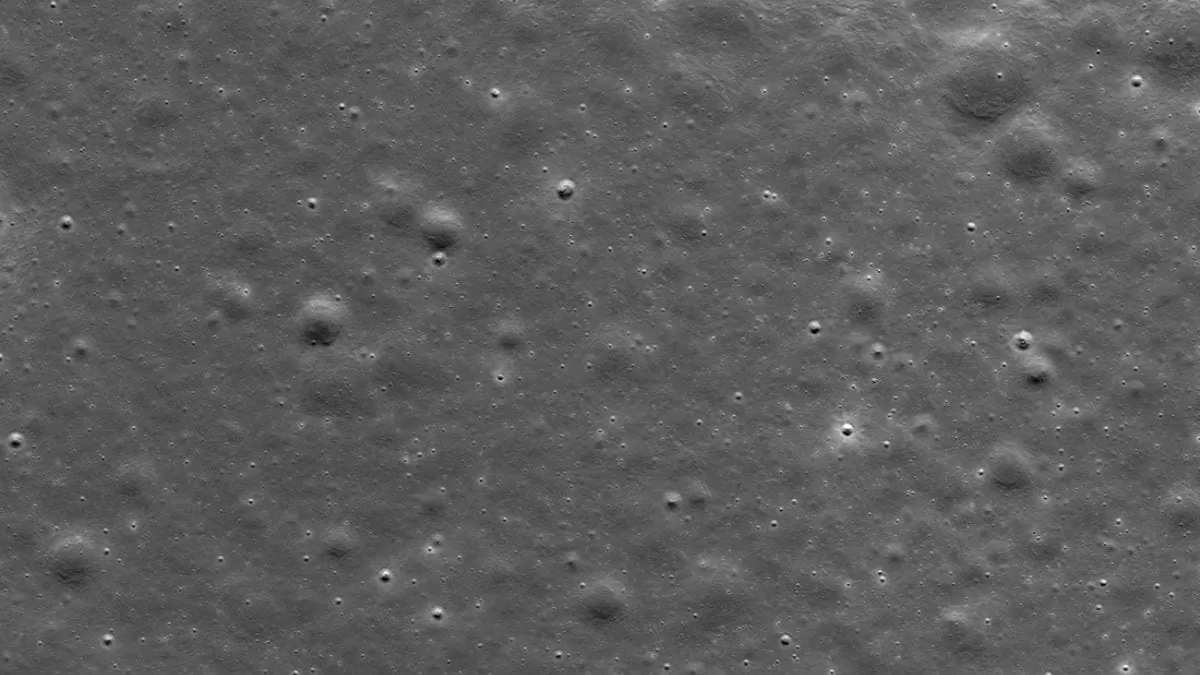
NASA’s ongoing efforts for space exploration have opened up a new chapter in commercial lunar exploration with the announcement of the planned landing site for ispace’s RESILIENCE lander. The Lunar Reconnaissance Orbiter (LRO), a NASA spacecraft, has successfully imaged Mare Frigoris, the chosen landing site for ispace’s mission, set to touchdown in June 2025. This partnership between NASA and ispace marks a significant milestone in commercial lunar exploration and sheds light on the scientific potential of this ancient volcanic region near the Moon’s north pole.
The LRO captured high-resolution images of Mare Frigoris, providing valuable information about the surface morphology and composition of this ancient volcanic region. These images have been crucial in the selection of the landing site for ispace’s RESILIENCE mission, which aims to explore and conduct scientific investigations on the Moon’s surface.
Mare Frigoris, also known as the Sea of Cold, is a vast plain located in the northern hemisphere of the Moon. This region is believed to have formed approximately 3.8 billion years ago due to volcanic activity. The LRO images have revealed intriguing features such as small volcanic cones, lava channels, and sinuous rilles, providing evidence of the region’s volcanic history. These features make Mare Frigoris an ideal location for scientific exploration and offer a glimpse into the Moon’s early evolution.
The selection of this landing site also holds immense significance for ispace, a Japanese lunar exploration company. As part of their “HAKUTO-R” program, ispace aims to develop technologies for lunar exploration and conduct various scientific investigations on the Moon. The RESILIENCE mission will be their first attempt at landing a spacecraft on the Moon’s surface and marks a crucial step in achieving their long-term goal of establishing a lunar resource utilization outpost.
The partnership between NASA and ispace is a testament to the growing opportunities in commercial space exploration. With NASA’s extensive experience and ispace’s innovative approach, this collaboration has the potential to pave the way for future commercial missions to the Moon and beyond.
Mare Frigoris offers a unique opportunity for scientific exploration with its diverse geological features and composition. This region hosts a wide variety of minerals, including ilmenite, olivine, and pyroxene, making it an attractive target for future resource utilization. Moreover, the north pole of the Moon is of particular scientific interest as it is continuously exposed to the Sun’s rays, providing a constant source of solar energy. This energy can be harnessed for various scientific and commercial purposes, making Mare Frigoris an ideal location for future lunar missions.
Apart from scientific exploration, this mission also holds a symbolic value, representing the growing international cooperation and partnerships in space exploration. The RESILIENCE mission will carry scientific payloads from various countries, including Japan, Canada, and the United States, showcasing the collaborative efforts in unlocking the mysteries of our Moon.
The LRO’s imaging capabilities have been instrumental in identifying the potential landing site for ispace’s RESILIENCE mission. The spacecraft’s high-resolution camera, LROC, has captured images with a resolution of up to 50 centimeters per pixel, providing detailed information about the surface features of Mare Frigoris. The LROC images have also been essential in identifying potential hazards and selecting a safe landing site for the RESILIENCE lander.
NASA’s Lunar Reconnaissance Orbiter has been in operation since 2009 and has played a crucial role in supporting future human and robotic exploration of the Moon. The spacecraft has been instrumental in mapping the Moon’s terrain, identifying potential landing sites, and providing valuable scientific data. The recent imaging of Mare Frigoris is yet another significant milestone in the LRO’s mission and its contributions to lunar exploration.
In conclusion, the LRO’s imaging of Mare Frigoris has not only helped ispace in selecting a potential landing site for their RESILIENCE mission but has also highlighted the scientific potential of this ancient volcanic region. This collaboration between NASA and ispace marks a significant step in commercial lunar exploration, showcasing the growing opportunities and potential for future missions. As we continue to explore and learn more about our Moon, Mare Frigoris presents a promising gateway for future discoveries and advancements in space exploration.
