
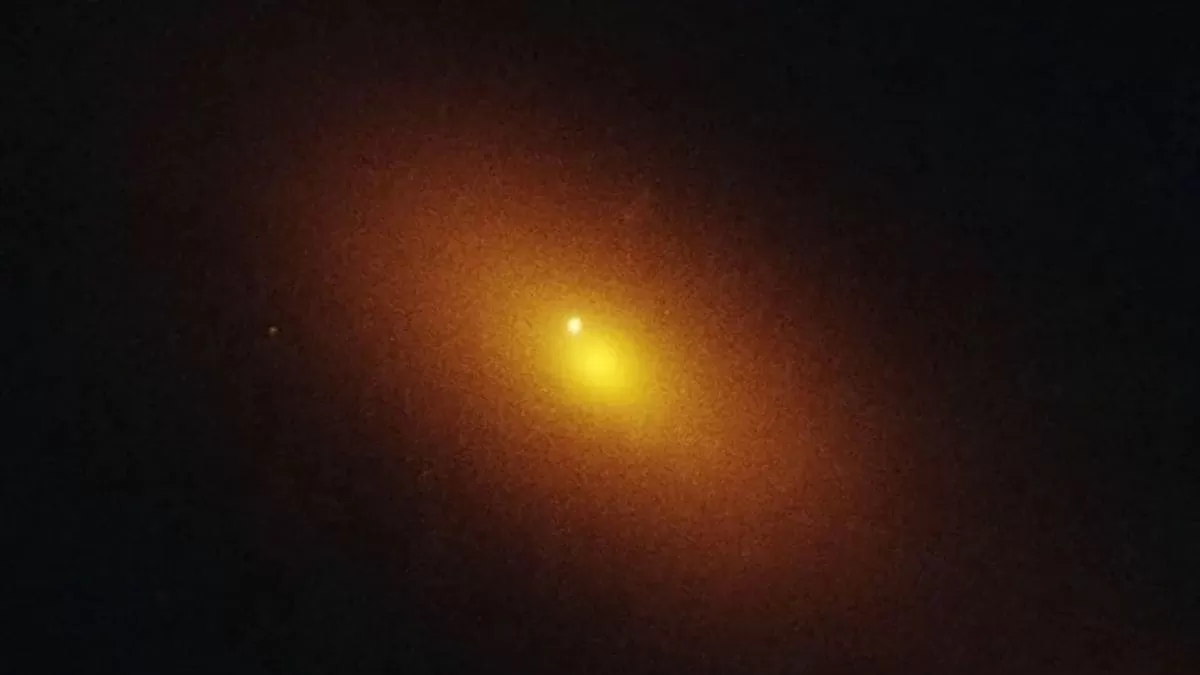
Astronomers have made a groundbreaking discovery that provides new insight into the mysterious behavior of supermassive black holes. Led by Dr. Yuhan Yao, a team of astronomers has identified the first offset tidal disruption event (TDE), where a rogue black hole outside a galaxy’s core has ripped apart a star. This historic finding was made possible through the combined efforts of the Hubble telescope and the Zwicky Transient Facility.
The concept of a tidal disruption event occurs when a star gets too close to a black hole and is torn apart by its immense gravitational pull. However, this new discovery is unique in that it involves a black hole that is not located at the center of its galaxy. This phenomenon, known as an offset TDE, has never been observed before and provides valuable information about the behavior of supermassive black holes.
The team’s findings, published in the Astrophysical Journal, reveal that the offset TDE occurred in a galaxy located 375 million light-years away. The event was first spotted by the Zwicky Transient Facility, a robotic sky survey that scans the night sky for transient objects such as supernovae and black hole flares. The Hubble telescope then confirmed the event and provided detailed images of the galaxy and the aftermath of the TDE.
According to Dr. Yao, this discovery is a significant step towards understanding the behavior of supermassive black holes. “We have always known that supermassive black holes can wander through galaxies, but this is the first time we have observed one in action,” she said. “This event provides us with a rare opportunity to study the effects of a wandering black hole on its surrounding environment.”
The team’s observations show that the offset TDE caused a burst of high-energy radiation as the black hole ripped apart the star. This radiation was detected by the Hubble telescope, providing valuable data for astronomers to analyze. The team also found that the black hole was moving at a speed of 2.7 million miles per hour, which is relatively slow for a supermassive black hole.
This new discovery challenges the traditional understanding of supermassive black holes and their behavior. It was previously believed that these black holes remain at the center of their galaxies, but this event proves otherwise. “This finding opens up a whole new realm of possibilities for studying the behavior of supermassive black holes,” said Dr. Yao.
The team’s discovery also has implications for future research on black holes. By studying the effects of a wandering black hole, scientists can gain a better understanding of how these objects interact with their surroundings and how they shape the evolution of galaxies. This could lead to new insights into the formation and growth of supermassive black holes.
The success of this discovery is also a testament to the power of collaboration and advanced technology. The Zwicky Transient Facility, which was responsible for detecting the event, is equipped with state-of-the-art cameras and software that can quickly identify and analyze transient objects in the night sky. The Hubble telescope, on the other hand, provided detailed images and data that confirmed the event and provided valuable information for further study.
In conclusion, the discovery of the first offset TDE by Dr. Yao and her team is a significant achievement in the field of astronomy. This event provides valuable insights into the behavior of supermassive black holes and opens up new avenues for research. With the advancement of technology and the dedication of scientists, we can expect many more groundbreaking discoveries in the future that will help us unravel the mysteries of the universe.
