
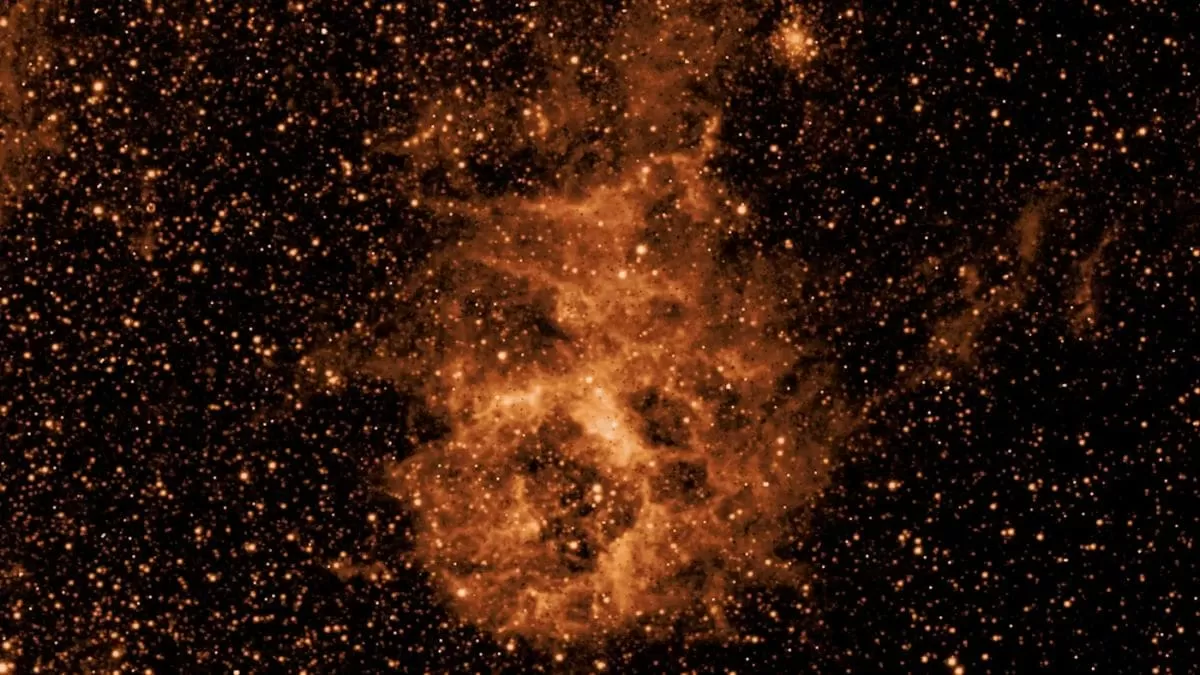
NASA, the National Aeronautics and Space Administration, has always been at the forefront of groundbreaking scientific discoveries. And now, they have taken another giant leap towards unlocking the mysteries of the universe with the launch of their latest space telescope – SPHEREx. This state-of-the-art observatory has officially begun its two-year mission to map the entire sky in infrared light, capturing 3,600 images per day and covering 102 different wavelengths.
The SPHEREx (Spectro-Photometer for the History of the Universe, Epoch of Reionization, and Ices Explorer) is a small explorer spacecraft, about the size of a washing machine, designed to observe and collect data on near-infrared light emitted from our universe. This mission is a collaboration between NASA and several scientific institutions, including the Jet Propulsion Laboratory, Caltech, and Johns Hopkins University.
One of the main objectives of the SPHEREx mission is to chart hundreds of millions of galaxies in 3D. This will help scientists gain a better understanding of the structure and evolution of the universe. By mapping the entire sky, the telescope will provide a comprehensive view of the cosmos, allowing us to study galaxies that have never been seen before, and potentially discover new ones.
But the SPHEREx mission is not just about mapping the universe; it has a much more ambitious goal. The observatory aims to uncover clues about the earliest moments of the universe, just after the Big Bang. By studying light from the early universe, scientists hope to understand the conditions that led to the formation of stars, galaxies, and eventually, life. This will help us piece together the puzzle of our existence and provide insights into the fundamental forces that govern our universe.
Furthermore, the SPHEREx telescope will also be able to detect and trace the presence of water and other molecules critical to life. This will help narrow down potential candidates for habitable planets outside our solar system. With the growing interest in space exploration and the search for extraterrestrial life, this mission could bring us one step closer to answering the age-old question – are we alone in the universe?
SPHEREx will be the first space telescope dedicated solely to mapping the entire sky in infrared light, providing a much deeper and clearer view than ever before. It is equipped with advanced technology, including a spectrometer and a multi-band instrument, which will enable it to capture images at multiple infrared wavelengths. This will allow scientists to study different aspects of the universe, from the dusty regions where stars are born to planetary systems.
The telescope will use a technique called spectroscopy, which breaks down the light from an object into its individual components, like a prism separating white light into different colors. By analyzing the spectrum of light, scientists can determine the chemical composition, temperature, and other characteristics of the object. This will help them identify the presence of molecules like water, carbon, and other crucial building blocks of life.
The SPHEREx mission is a prime example of the advancements in space technology and the power of collaboration between different scientific institutions. It is a remarkable achievement that is set to push the boundaries of our knowledge and understanding of the universe. And this is just the beginning; the data collected by SPHEREx will be invaluable to future space missions, and the possibilities are endless.
The telescope will operate in a unique orbit, circling the Earth twice a day and covering the entire sky every six months. This orbit will ensure that the telescope always has a view of the entire sky, without any interruptions from the Earth’s rotation. It will also avoid any interference from the Sun, the Moon, and other celestial objects.
During its two-year journey, SPHEREx will capture around 3.2 million images, covering billions of objects. The data collected will be processed and made available to the public, allowing anyone to explore the universe and make new discoveries. This mission is not just for scientists; it is for everyone who is curious about the mysteries of the universe.
In conclusion, the launch of NASA’s SPHEREx space telescope marks another significant milestone in space exploration. This mission has the potential to revolutionize our understanding of the universe and open up new avenues for future research. With its cutting-edge technology and ambitious goals, SPHEREx is set to change the way we see and study our universe. And who knows, it may even bring us one step closer to answering the ultimate question – what is our place in the grand scheme of things?
