
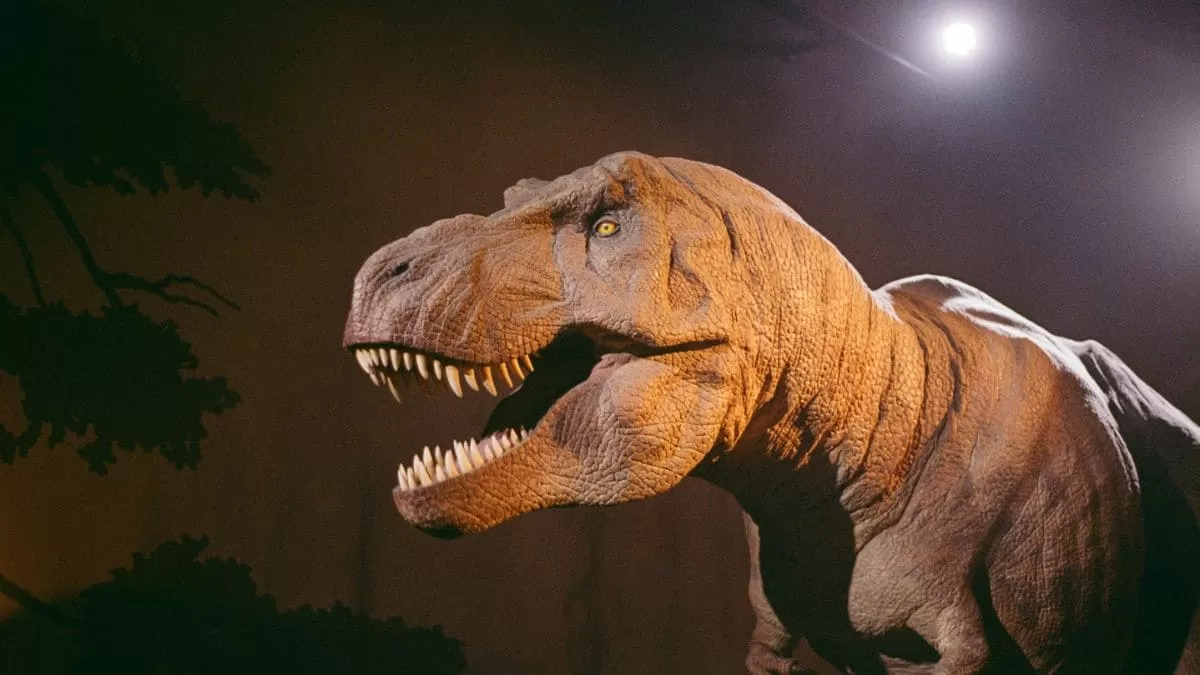
A new study conducted by researchers at University College London (UCL) has shed light on the evolution of one of the most iconic dinosaurs, the Tyrannosaurus rex. The study, which was published in the journal Nature Communications, reveals that the T. rex evolved in North America but had ancestors that migrated from Asia over 70 million years ago. This groundbreaking research also suggests that the T. rex’s enormous size can be attributed to global cooling after a major climatic peak 92 million years ago. As other predators died out, the tyrannosaurids and their descendants were able to thrive and dominate the prehistoric landscape.
The T. rex is undoubtedly one of the most famous and fascinating creatures to have ever roamed the Earth. With its massive size, sharp teeth, and powerful jaws, it has captured the imagination of people for generations. However, the origins of this fearsome predator have always been a mystery. The new study, led by UCL researchers, has finally provided some answers.
The team of scientists analyzed fossil records from North America and Asia to trace the evolutionary history of the T. rex. They found that the T. rex’s ancestors were smaller and lived in Asia around 100 million years ago. These smaller tyrannosaurids then migrated to North America, where they eventually evolved into the T. rex we know today.
Dr. Chris Barker, lead author of the study, explains, “We were able to track the evolution of the T. rex back to its ancestors in Asia. This suggests that the T. rex’s ancestors were able to cross over from Asia to North America, which was connected by a land bridge at the time.”
The researchers also discovered that the T. rex’s size was closely linked to global cooling. Around 92 million years ago, there was a major climatic peak that caused a drop in temperature worldwide. This cooling period led to the extinction of many large predators, leaving a gap in the ecosystem that the T. rex and other tyrannosaurids were able to fill.
Dr. Barker adds, “The T. rex’s size was a result of the perfect combination of factors – migration, evolution, and climate change. As other predators died out, the T. rex and its relatives were able to grow larger and dominate the landscape.”
The study also sheds light on the diversity of tyrannosaurids during the Late Cretaceous period. The researchers found that there were at least four different species of tyrannosaurids living in North America at the time, including the T. rex. This suggests that the T. rex was not the only dominant predator in its environment and had to compete with other species for resources.
Dr. David Hone, co-author of the study, says, “The T. rex was not the only tyrannosaurid in North America, but it was certainly the largest and most iconic. This study helps us understand the complex ecosystem in which the T. rex lived and how it was able to thrive and become the top predator.”
The findings of this study have significant implications for our understanding of the T. rex’s evolution and its role in the prehistoric world. It also highlights the importance of studying the past to better understand our present and future.
Dr. Barker concludes, “The T. rex is a fascinating creature that continues to capture our imagination. This study provides new insights into its evolutionary history and how it became the ultimate predator. We hope that our research will inspire others to continue exploring and uncovering the mysteries of the prehistoric world.”
In conclusion, the new study led by UCL researchers has revealed that the T. rex evolved in North America but descended from ancestors that migrated from Asia over 70 million years ago. The study also connects the T. rex’s enormous size to global cooling after a major climatic peak 92 million years ago. This groundbreaking research not only sheds light on the T. rex’s evolution but also highlights the importance of studying the past to understand our present and future. The T. rex will continue to fascinate and amaze us, and with each new discovery, we get one step closer to understanding this magnificent creature.
