
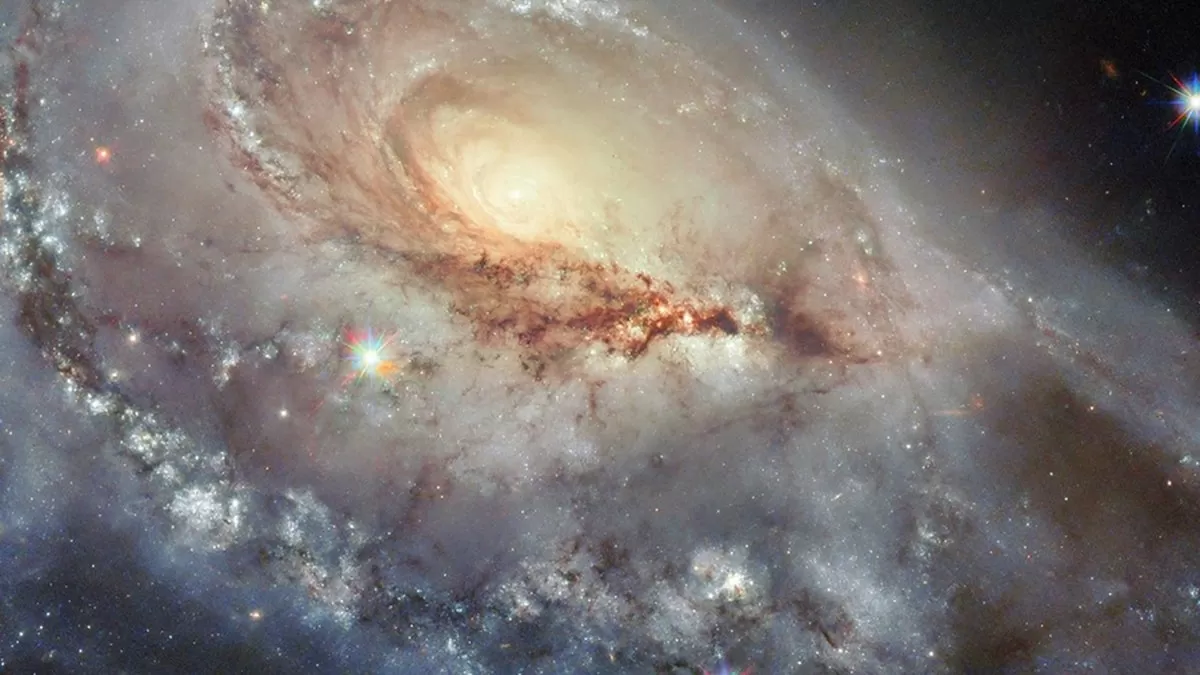
Arp 184, also known as NGC 1961, is a stunning yet asymmetrical spiral galaxy captured by NASA/ESA’s Hubble Space Telescope. Located about 190 million light-years away in the Camelopardalis constellation, it features a single, starry spiral arm and a rich history of supernovae. This unique and captivating galaxy has been included in Halton Arp’s Atlas of Peculiar Galaxies, standing out due to its irregular shape and fascinating characteristics.
The discovery of Arp 184 dates back to the 19th century, when astronomer William Herschel first observed it in 1788. However, it wasn’t until 1966 that it was officially catalogued as a peculiar galaxy by Halton Arp, an American astronomer known for his work on galaxy classification. Arp 184’s peculiarities lie in its asymmetrical shape, with a single spiral arm extending outwards from its central bulge. This is in contrast to most spiral galaxies, which typically have two or more symmetrical arms.
The single spiral arm of Arp 184 is a result of a gravitational interaction with a neighboring galaxy, which has caused the gas and dust within the galaxy to be pulled in one direction. This interaction has also triggered the formation of new stars, giving the galaxy its bright and starry appearance. The asymmetry of Arp 184 makes it a prime target for astronomers studying galaxy evolution and the effects of interactions between galaxies.
In addition to its unique shape, Arp 184 also has a rich history of supernovae. These are powerful explosions that occur at the end of a star’s life, and they can outshine an entire galaxy for a brief period of time. Arp 184 has had at least three recorded supernovae, the most recent one occurring in 2001. These supernovae provide valuable insights into the life cycle of stars and the processes that shape galaxies.
The Hubble Space Telescope’s image of Arp 184 showcases its stunning beauty and intricate details. The telescope’s powerful cameras and instruments have allowed astronomers to study this galaxy in great detail, revealing its complex structure and the various stages of star formation within it. The image also highlights the galaxy’s bright core, which is home to a supermassive black hole that is actively feeding on surrounding gas and dust.
Arp 184’s inclusion in Halton Arp’s Atlas of Peculiar Galaxies is a testament to its uniqueness and scientific significance. This atlas, published in 1966, contains a collection of 338 galaxies that exhibit peculiar features, such as distorted shapes, unusual structures, or interactions with other galaxies. These galaxies have provided astronomers with valuable insights into the processes that shape the universe and have sparked further research and discoveries.
The study of Arp 184 and other peculiar galaxies is crucial in our understanding of the universe and its evolution. By studying these galaxies, astronomers can gain insights into the formation and evolution of galaxies, the role of interactions between galaxies, and the life cycle of stars. The Hubble Space Telescope’s image of Arp 184 has allowed us to appreciate the beauty and complexity of this galaxy, while also providing valuable scientific data for further research.
In conclusion, Arp 184, also known as NGC 1961, is a stunning and unique spiral galaxy located in the Camelopardalis constellation. Its single spiral arm, rich history of supernovae, and inclusion in Halton Arp’s Atlas of Peculiar Galaxies make it a fascinating subject for astronomers. The Hubble Space Telescope’s image of this galaxy has allowed us to appreciate its beauty and complexity, while also providing valuable insights into the processes that shape our universe. Arp 184 is a true gem in the vast expanse of space, and its study will continue to contribute to our understanding of the cosmos.
