
NASA’s Juno probe has been making groundbreaking discoveries since it entered Jupiter’s orbit in 2016. Recently, the probe has uncovered some fascinating new information about the gas giant and its moons, specifically the north pole of Jupiter and the volcanic moon Io.
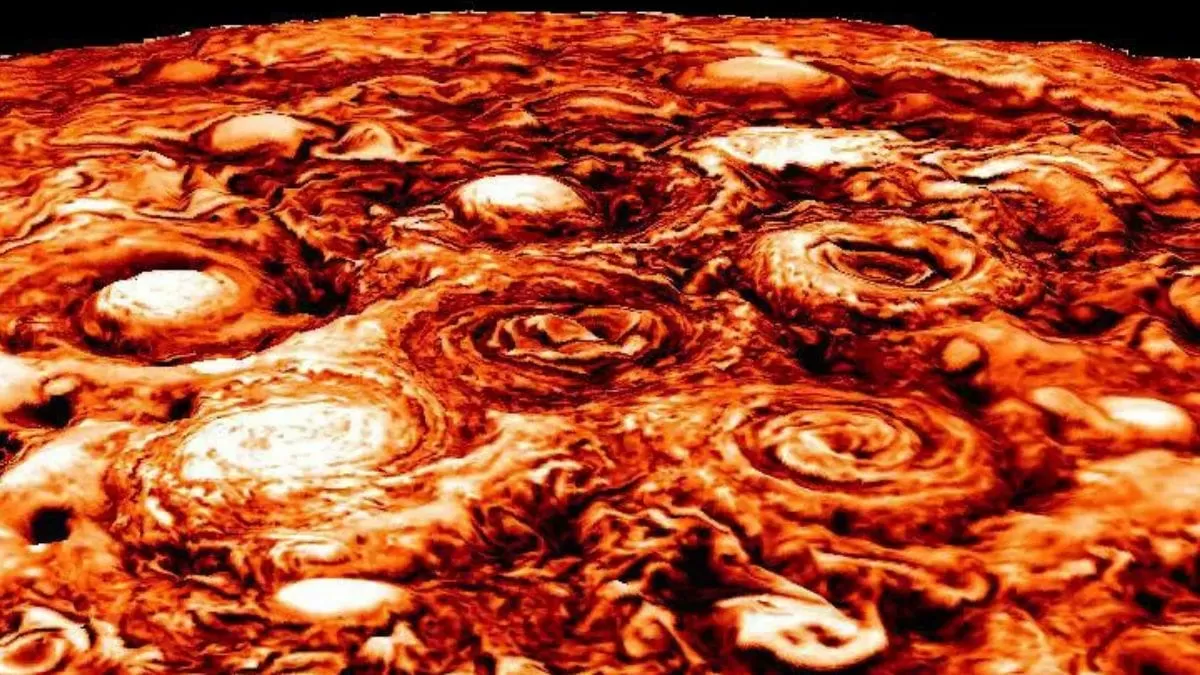
Using thermal and microwave instruments, scientists have been able to track atmospheric chaos and subsurface lava flows on Jupiter’s north pole. This has given us a new understanding of the extreme weather patterns on the planet. The data collected by Juno has revealed colliding cyclones, swirling around the north pole, creating a stunning and chaotic display of atmospheric activity.
These cyclones, some as large as 870 miles in diameter, have been observed to be moving in opposite directions, creating a chaotic and unpredictable weather pattern. This discovery has reshaped our understanding of the gas giant’s atmosphere and its complex weather systems.
But the surprises don’t end there. Juno’s instruments have also detected flowing magma beneath the crust of Jupiter’s volcanic moon, Io. This is the first time that such activity has been observed on Io, and it has given scientists a rare glimpse into the moon’s interior.
Io is known for its intense volcanic activity, with over 400 active volcanoes on its surface. However, this new discovery shows that the volcanic activity on Io goes even deeper, with magma flowing underneath the moon’s crust. This has led to a better understanding of how Io’s volcanic activity is sustained and how it affects the moon’s surface.
The data collected by Juno has also given us a better understanding of the magnetic field around Jupiter. The probe has detected a strong magnetic field around the planet, which is about 20 times stronger than Earth’s. This magnetic field is believed to be generated by the metallic hydrogen deep within Jupiter’s core.
These discoveries not only give us a better understanding of Jupiter and its moons, but they also have implications for our understanding of other gas giants in our solar system and beyond. The data collected by Juno has provided scientists with valuable insights into the dynamics of gas giants and their moons, which will further our understanding of the universe.
The success of the Juno mission is a testament to the hard work and dedication of the scientists and engineers at NASA. The probe has been able to collect valuable data and images, despite the intense radiation and extreme conditions in Jupiter’s orbit.
The discoveries made by Juno have also sparked new questions and avenues for research. Scientists are now eager to continue studying the gas giant and its moons, in hopes of uncovering even more secrets about our solar system and the universe.
The Juno probe is scheduled to continue its mission until at least July 2021, giving us plenty of time to gather more data and make even more groundbreaking discoveries. With each new piece of information, we are getting closer to unraveling the mysteries of our solar system and the universe.
In conclusion, NASA’s Juno probe has once again proven to be a valuable asset in our quest to understand the wonders of our solar system. The recent discoveries of colliding cyclones on Jupiter’s north pole and flowing magma on Io have given us new insights into the gas giant and its moons. These discoveries have reshaped our understanding of the Jovian system and have sparked new questions and avenues for research. With each new discovery, we are getting closer to unlocking the secrets of the universe.
