
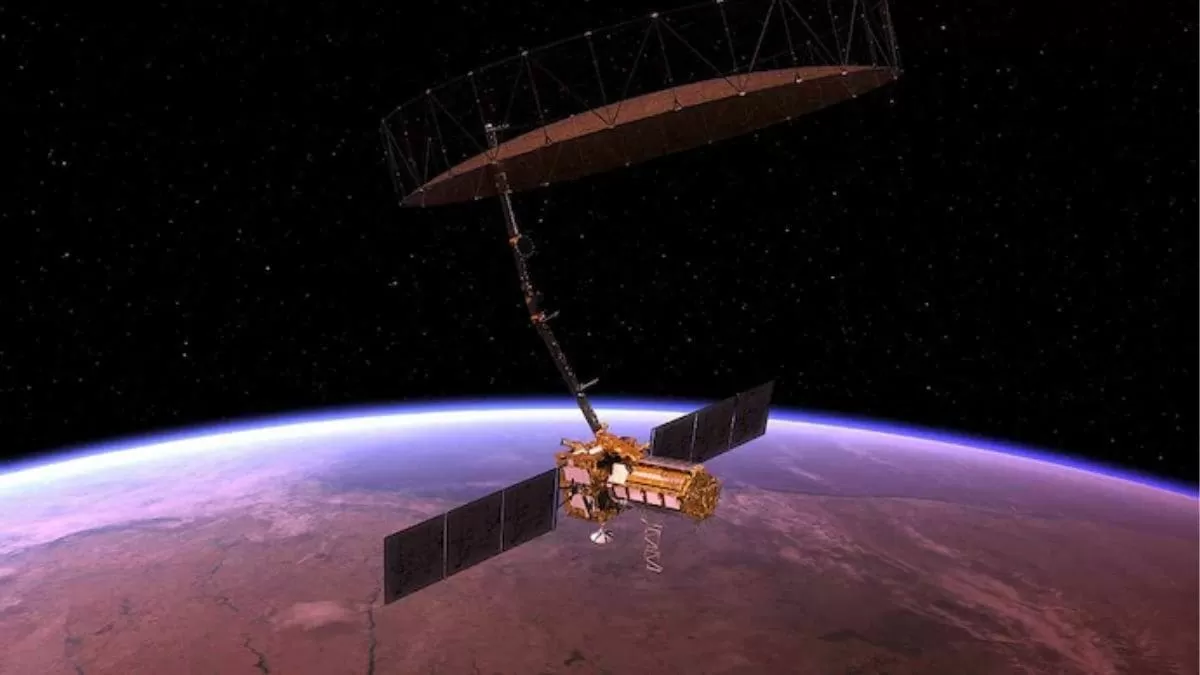
NISAR, the joint NASA-ISRO satellite mission, is set to make history in June 2025 as it finally overcomes technical issues and prepares for launch. This groundbreaking mission will monitor Earth’s surface with advanced radar imaging, providing crucial insights into our planet’s dynamic changes.
The NASA-ISRO Synthetic Aperture Radar (NISAR) mission has been in the works for over a decade, with the two space agencies collaborating to create a state-of-the-art satellite that will revolutionize our understanding of Earth’s surface. However, the mission has faced numerous setbacks, the most recent being concerns over the 12-meter radar antenna overheating.
But after years of diligent work and innovative solutions, the NISAR team has successfully resolved the technical issues and is now ready to launch the satellite into orbit. The launch, initially planned for 2022, has been rescheduled for June 2025, giving the team ample time to conduct thorough tests and ensure a successful mission.
So, what makes NISAR such a game-changing mission? The answer lies in its advanced radar imaging capabilities. The satellite will carry two radar instruments, one from NASA and the other from ISRO, which will work in tandem to provide unprecedented views of Earth’s surface. This will allow scientists to track changes in land and ice, monitor natural disasters, and study the effects of climate change.
The NASA instrument, called L-band Synthetic Aperture Radar (SAR), will use radio waves to map Earth’s surface at a resolution of 30 meters. This means that even objects as small as a car or a small boat can be detected and tracked. The ISRO instrument, known as S-band SAR, will operate at a higher frequency, providing images at a resolution of 12 meters. This will enable scientists to study smaller features such as individual trees and buildings.
The combination of these two instruments will provide a comprehensive view of Earth’s surface, allowing scientists to track changes over time with unprecedented accuracy. This will be especially useful in monitoring natural disasters such as floods, earthquakes, and landslides, and in predicting their impact. NISAR will also play a crucial role in studying the effects of climate change on our planet’s surface, providing valuable data for research and decision-making.
But NISAR’s capabilities go beyond just monitoring Earth’s surface. The satellite will also have the ability to measure changes in Earth’s topography with incredible precision. This will help scientists track sea level rise, map ocean currents, and study the movement of glaciers and ice sheets. Such insights will be invaluable in understanding the impact of climate change on our planet’s oceans and polar regions.
Moreover, NISAR will also have the ability to penetrate clouds and vegetation, providing images of Earth’s surface even in areas with heavy cloud cover or dense forests. This will be particularly useful in monitoring areas that are difficult to access, such as remote regions and developing countries.
The launch of NISAR marks a significant milestone in the collaboration between NASA and ISRO. The two space agencies have been working together on various missions for decades, but NISAR is their most ambitious joint project yet. The successful resolution of technical issues and the upcoming launch of the satellite are a testament to the dedication and expertise of the teams from both agencies.
Once in orbit, NISAR will join a fleet of Earth-observing satellites, providing a new level of detail and accuracy in monitoring our planet. The data collected by NISAR will be freely available to scientists and researchers around the world, fostering collaboration and driving groundbreaking discoveries.
In conclusion, the launch of NISAR in June 2025 is eagerly awaited by the scientific community and space enthusiasts alike. This joint NASA-ISRO mission promises to provide unprecedented insights into Earth’s surface, revolutionizing our understanding of our planet and its dynamic changes. As we countdown to the launch of NISAR, we can only imagine the incredible discoveries and advancements that this mission will bring.
